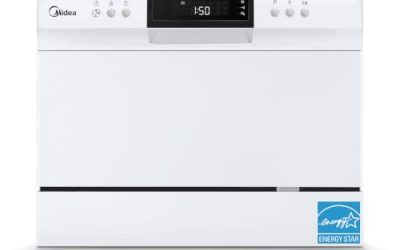
Our Short List of 3
All 5 Picks at a Glance
| Product | Specs | Action |
|---|---|---|
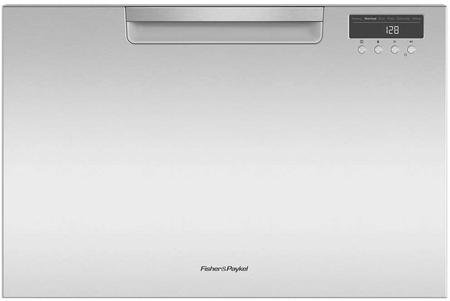
| Fisher & Paykel DD24SAX9 N Single DishDrawer — 1.9 gallons per cycle | Check price on Amazon | |
 COMFEE’ CDC22P2AWW Countertop Dishwasher — 2.0 gallons per cycle | Check price on Amazon | |
 LG LDFN4542S — 2.9 gallons per cycle | Check price on Amazon | |
 Kenmore 22-14675 — 3.0 gallons per cycle | Check price on Amazon | |
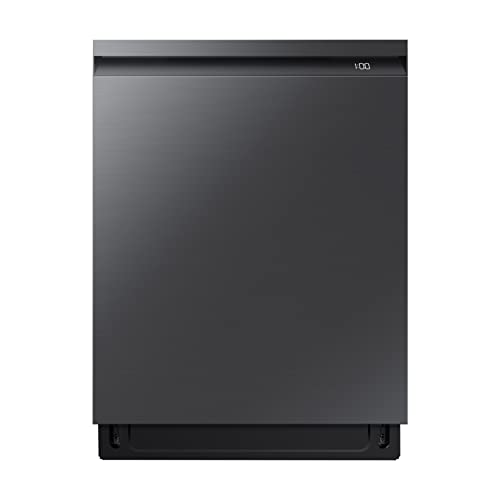 Samsung DW80B6060UG/AA — 3.2 gallons per cycle | Check price on Amazon |
Key takeaways
- The best dishwashers based on water usage, ranked strictly by certified gallons per cycle, from a 1.9-gallon drawer to full-size models at 3.2 gallons.
Most dishwasher guides treat water use as one bullet point among many. This one does the opposite: every model below is ranked by a single number, the certified gallons-per-cycle figure published in its ENERGY STAR certification record, measured under the U.S. Department of Energy test procedure. No feature scores, no popularity weighting — the ladder runs from the lowest certified figure to the highest. It is useful if a water bill, a septic system, a well, or a local restriction makes per-cycle water the deciding factor, and as a reality check: the gap between the thirstiest and leanest certified machines sold today is wider than most buyers expect. All five picks are real dishwashers sold on Amazon US, and every figure comes from the model’s certification record, its Amazon listing, or the maker’s own specification.
Disclosure: As an Amazon Associate, we earn from qualifying purchases. Product details and availability can change; check the Amazon listing before you buy.
Quick picks at a glance
| Rank | Product | ASIN | Certified water use | Best for |
|---|---|---|---|---|
| 1 | Fisher & Paykel DD24SAX9 N Single DishDrawer | B01MQGDIAR | 1.9 gallons per cycle | Small households washing little and often |
| 2 | COMFEE’ CDC22P2AWW Countertop Dishwasher | B096RYWSQM | 2.0 gallons per cycle | Renters and small kitchens with no built-in opening |
| 3 | LG LDFN4542S | B0BDMR9745 | 2.9 gallons per cycle | Full-size capacity at the lowest certified figure in its class |
| 4 | Kenmore 22-14675 | B0CFPNG5TW | 3.0 gallons per cycle | Families that want a third rack without leaving the low-water group |
| 5 | Samsung DW80B6060UG/AA | B0B9GHTQ1F | 3.2 gallons per cycle | Buyers who want connected features and strong wash hardware at a lean figure |
What matters most when you compare dishwashers by water usage
The certified figure is the only fair comparison. Makers advertise water use in different ways: one quotes its eco cycle, another a quick cycle, a third a range. The ENERGY STAR record removes that freedom — each certified model is measured under the same federal test procedure, and that gallons-per-cycle figure is the one used in the ranking above. When a listing field and the certification record disagree — and below, one of them does — this guide uses the certification record and says so.
Know the two federal baselines. Standard-size dishwashers are certified against a federal maximum of 5.0 gallons per cycle; compact models, a class that includes countertop units and single drawers, against 3.5 gallons per cycle. Every pick here sits well under its class baseline — but a compact machine’s figure should not be compared raw against a full-size machine’s without also looking at capacity.
Divide by place settings before you judge. A gallon figure means little until you set it against what the machine holds. The LG below washes 15 place settings on 2.9 certified gallons — about 5.2 place settings per gallon; the single DishDrawer washes 7 settings on 1.9 gallons, about 3.7 per gallon. The LG is the more efficient machine per dish washed; the drawer wins only on absolute water per run.
The certified figure is a test-cycle figure, not a promise for every cycle. Maker cycle charts show how far real use can drift: heavy cycles use more water, eco and light cycles use less, and soil-sensing models vary the fill from load to load. Treat the certified number as the comparison anchor, then check the cycle chart of any model you shortlist for the programs you actually run.
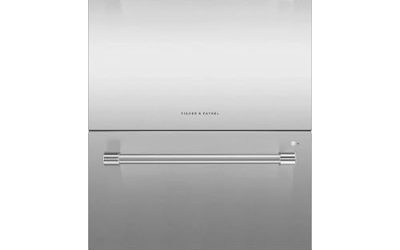
Fisher & Paykel DD24SAX9 N Single DishDrawer — 1.9 gallons per cycle
Why it fits a water-first brief. This is the lowest certified per-cycle figure in this guide, low for a structural reason: the drawer is a genuinely small tub, so a cycle has less volume to fill. Fisher & Paykel’s double-drawer sibling makes the arithmetic visible — the maker publishes 3.44 gallons for a cycle running both tubs, about 1.72 gallons per drawer, in line with the single drawer’s certified 1.9. If your household generates a half-load at a time and runs the machine little and often, no full-size model can match it.
Trade-offs. Seven place settings is a hard ceiling: a family dinner overflows into a second cycle, and two 1.9-gallon cycles erase the advantage over one 2.9-gallon full-size load. There is no soil sensing, so the figure does not adapt down for a light load. The tub is plastic rather than stainless, and the drawer fills only half of a standard opening, leaving a gap to close with cabinetry.
Best for / Skip if. Best for one- and two-person households, small kitchens, and anyone whose water constraint is total gallons per run. Skip it if you regularly wash for four or more people, or want a standard drop-door machine.
COMFEE’ CDC22P2AWW Countertop Dishwasher — 2.0 gallons per cycle
Why it fits a water-first brief. The COMFEE’ is the only countertop machine in this guide, and its certified 2.0 gallons per cycle is remarkable for the format — within a tenth of a gallon of the DishDrawer’s figure, with a conventional rack layout for six place settings. The listing’s marketing quotes higher per-program numbers (its Speed program is described at 2.77 gallons), which is exactly why this guide ranks on the certification record instead: under the shared federal test, this is a 2.0-gallon dishwasher. For a renter who cannot install a built-in, it is also the lowest-water route to machine washing — a running faucet during hand washing passes more water than any figure here within minutes.
Trade-offs. Six place settings and a countertop tub mean large pans compete for limited space. Air drying leaves plastics wetter than the fan-assisted and door-opening systems further down this list. The faucet hookup occupies the sink tap while it runs, and at 49 dB it is the loudest pick here.
Best for / Skip if. Best for renters, dorms, RVs and small apartments with no built-in opening. Skip it if you have a standard 24-inch opening — the full-size picks below wash more than twice the load for less than a gallon more per cycle.
LG LDFN4542S — 2.9 gallons per cycle
Why it fits a water-first brief. Among full-size, standard-class dishwashers, 2.9 certified gallons per cycle is the strongest figure in this guide, and set against 15 place settings it is also the best capacity-per-gallon result here — about 5.2 place settings washed per gallon. The low figure does not come from shrinking the tub. LG’s own cycle guide is a useful honesty check: its published per-cycle ranges run from 1.8 gallons on the lightest program to about 5.4 on the heaviest. The certified 2.9 is the standardised anchor; your real average sits wherever your cycle habits put it.
Trade-offs. The third rack is fixed rather than adjustable, so tall stemware below it needs care. Dynamic Dry has no heated element or auto-opening door, so plastics are not its strength. Front controls are easy to brush against in a narrow galley kitchen.
Best for / Skip if. Best for families who run full loads and want the lowest certified water figure a standard 24-inch built-in offers in this group. Skip it if absolute water per run matters more than per-dish efficiency — the compact picks above use less on every cycle.
Kenmore 22-14675 — 3.0 gallons per cycle
Why it fits a water-first brief. The Kenmore pairs its certified 3.0 gallons per cycle with the leanest energy figure among the standard-class picks: 234 kWh per year in its certification record. It reaches the low water figure with a full feature set — a removable EasyFlex third rack, an adjustable upper rack, and soil sensing that adjusts temperature, pressure and cycle time to the load rather than running a fixed program. A Half Load option gives smaller washes a dedicated program instead of a full-tub cycle.
Trade-offs. One figure needs care: the Amazon listing’s spec field states water consumption of 4.5 gallons, while the model’s ENERGY STAR certification record states 3.0 gallons per cycle under the federal test. This guide ranks on the certification record, as it does for every pick, but a buyer comparing listing pages will see the higher number and should know which basis each figure stands on. Confirm part number 2214675 before ordering; the range uses several closely numbered variants.
Best for / Skip if. Best for families who want a third rack, soil sensing and the lowest certified energy figure in the full-size group, at a water figure only a tenth of a gallon behind the LG. Skip it if you want every published figure — listing and registry alike — to agree; this ladder has one disagreement and this is it.
Samsung DW80B6060UG/AA — 3.2 gallons per cycle
Why it fits a water-first brief. The Samsung closes the ladder at 3.2 certified gallons per cycle — the highest figure in this guide, still 36 percent under the federal standard-class maximum of 5.0 gallons, with listing and certification record in full agreement on the number. What the extra fractions of a gallon buy is hardware: StormWash+ adds a rotating jet and a Pre Blast stage aimed at baked-on loads, the AutoRelease door pops open at cycle end to speed drying, and at 44 dBA it is the quietest full-size pick here. Its cycle chart shows the same pattern as the LG’s — the certified figure belongs to the test cycle, while Pots and Pans is charted at 5.4 gallons.
Trade-offs. Samsung’s own materials disagree on this model’s place-setting count, so this guide does not print one; judge capacity by its three-rack layout instead. The connected features depend on the SmartThings app, which only helps if you will use it. And on the single measure this guide ranks by, it finishes last of the five.
Best for / Skip if. Best for buyers who want the strongest wash-and-dry hardware in the group and accept a certified figure a few tenths above the leaders. Skip it if water use is your only criterion — in that case it is fourth or fifth on your list by definition.
How to choose between these picks
Start with your constraint. If it is absolute gallons per run — a small well tank, a strict water budget, a tiny household that never fills a big tub — the ladder order is your answer: the DishDrawer at 1.9 and the COMFEE’ at 2.0 use the least water every cycle. If the constraint is gallons per dish washed, reverse your thinking: the LG’s 2.9 gallons spread over 15 place settings is the most efficient full load in the guide, and the Kenmore matches it closely with the leanest certified energy figure. Choose the Samsung only when wash hardware and drying matter alongside water, not instead of it. And if you live on heavy cycles, compare maker cycle charts rather than certified badges — a heavy program can use close to twice the certified figure on any of these machines.
Habits and care that keep real water use near the certified figure
The certified number assumes a standard load on the test cycle; your habits decide how close you land to it. Scrape plates into the bin instead of rinsing them under a running tap first — pre-rinsing can use more water than the entire certified cycle of the top picks here. Run full loads: two half loads on the full-size picks use roughly double the water of one full load, while the DishDrawer exists for households that cannot fill a tub. Use Auto or Eco for everyday loads and keep Heavy for baked-on cookware. Keep the filter clean and the spray-arm holes clear — a clogged arm lengthens cycles and tempts re-runs, and a re-run is the costliest outcome in water terms.
FAQ
Is the certified gallons-per-cycle figure the amount my dishwasher will use every time?
No. It is the result under the federal test procedure, on the test cycle, and it exists so models can be compared on one basis. Real cycles vary: maker charts for the LG in this guide span 1.8 to about 5.4 gallons depending on program and soil level. Use the certified figure to rank models, and the maker’s cycle chart to predict your own use.
Why does the Kenmore listing show 4.5 gallons when this guide ranks it at 3.0?
The listing’s spec field and the model’s ENERGY STAR certification record state different figures. The record — 3.0 gallons per cycle for the 1467 family, which includes the 14675 — is measured under the federal test procedure, so this guide ranks on it and flags the disagreement rather than hiding it.
Does a lower water figure mean weaker cleaning?
Not by itself. The certified figure measures water delivered per test cycle, not soil removal. The full-size picks pair their figures with multi-arm spray systems and soil sensing, and the Samsung’s chart shows its heavy program using more water when the load demands it. Judge cleaning by wash system and cycle range; judge water by the certified figure.
Is a countertop or drawer model always the lowest-water choice?
Per cycle, yes — smaller tubs move less water, and the two compact picks top this ranking. Per dish washed, no: the full-size LG washes about 5.2 place settings per certified gallon against the drawer’s 3.7. Households running full loads save more water with the efficient full-size machine; households running small loads save more with the compact one.
Conclusion
Ranked strictly on certified water use, the order is clear. For the lowest figure of all, the Fisher & Paykel single DishDrawer at 1.9 gallons suits small households that wash little and often. For renters and compact kitchens, the COMFEE’ countertop matches it at 2.0 gallons with no installation. For families running full loads, the LG LDFN4542S is the water-first pick that matters most: 2.9 certified gallons across 15 place settings is the best per-dish efficiency in this guide, with the Kenmore 22-14675 a tenth of a gallon behind and the leanest on certified energy. The Samsung DW80B6060UG closes the list at 3.2 gallons — last on this single measure, first in this group for wash hardware and drying, and still well under the federal maximum.