Our Short List of 3
All 3 Picks at a Glance
| Product | Specs | Action |
|---|---|---|
 COMFEE’ Countertop Dishwasher (CDC22P2AWW) | Check price on Amazon | |
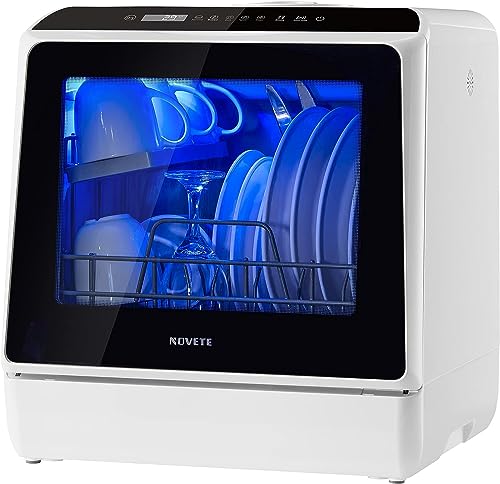 NOVETE Portable Countertop Dishwasher (TDQR01) | Check price on Amazon | |
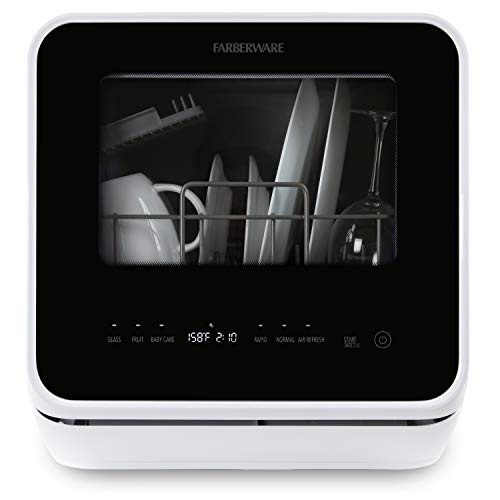 Farberware Complete Portable Countertop Dishwasher (FDW05ASBWHA) | Check price on Amazon |
Key takeaways
- The best low cost dishwashers for small kitchens: three verified entry-level countertop models compared on capacity, wash cycles, water use and drying.
A low cost dishwasher is not really about a number on a tag. It is about the feature set you settle for: a countertop cabinet instead of a built-in installation, a handful of core wash programs instead of a long menu, a plastic or basic stainless interior, and no plumber, no cabinet work and no permanent hookup before the first load runs. For renters, dorm rooms, small apartments, RVs and anyone adding a first machine to a kitchen that never had one, that entry-level feature set is exactly the point.
This guide is for buyers who want the lowest total commitment — in money, in installation effort and in counter space — while still getting a real machine wash instead of a sink full of soaking dishes. Every pick below was checked against its current Amazon US listing, and the specifications quoted come from those listings and the makers’ own product information. The comparisons rest only on published figures such as capacity, dimensions, cycle lists, water use and annual energy consumption.
One honest note on scope: the entry-level machines that could be verified as currently sold on Amazon US for this guide are countertop models. That is where the low cost end of the market genuinely sits, because skipping built-in installation removes a whole layer of expense and commitment. If you have a standard dishwasher cutout and want a full-size built-in, these picks will not fit that opening — they are made for counters, carts and utility shelves.
Disclosure: As an Amazon Associate, we earn from qualifying purchases. Product details and availability can change; check the Amazon listing before you buy.
Quick picks at a glance
| Product | ASIN | Best for |
|---|---|---|
| COMFEE’ Countertop Dishwasher (CDC22P2AWW) | B096RYWSQM | Most capacity and the widest cycle choice in this group |
| NOVETE Portable Countertop Dishwasher (TDQR01) | B089YD3Z91 | Running with no faucet hookup, and true hot-air drying |
| Farberware Complete Portable Countertop Dishwasher (FDW05ASBWHA) | B07VR22832 | The smallest footprint for one person or a tight counter |
What matters most when you buy at the low cost end
Installation route comes first. Entry-level dishwashers split into two camps: faucet-fed models that clip onto your kitchen tap while they run, and tank models with a built-in reservoir you fill by hand. A tank model can sit anywhere near an outlet and a sink for draining. A faucet model frees you from refilling but ties up the tap during the cycle and needs a faucet thread the adapter can grip. Decide which routine fits your kitchen before comparing anything else.
Capacity is measured in place settings, and the figures are optimistic. A place setting is a standardized bundle of plates, bowls, cups and cutlery. In daily use, a 6 place setting countertop machine realistically handles a day of dishes for two or three people, a 4 place setting model suits one or two people, and a 2 place setting model is a one-person machine. Bulky pots and baking trays rarely fit in any of them, so plan on hand-washing your largest cookware.
Plate diameter is the hidden limit. Countertop cabinets are short. The models below accept plates from 10 to 12 inches across, sometimes only when loaded at an angle. Measure your everyday dinner plates before ordering; oversized stoneware is the most common reason these machines disappoint.
A short cycle list is normal at this level. Expect four to eight programs built around the same core: a normal wash, a rapid or speed wash, an eco wash, a glass or delicate wash and, on some models, a high-temperature baby-care program. What you give up versus full-size machines is soil sensing, auto-open drying doors, third racks and sanitize certifications — not basic cleaning.
Drying is the weakest point of entry-level machines. Most countertop models rely on residual heat and airflow, which leaves plastics damp. A model with a dedicated hot-air dry mode is the exception worth paying attention to if dry dishes straight from the machine matter to you. Opening the door a crack right after the cycle ends helps every model in this group.
Running figures decide the long-term cost. Water use per cycle and the annual energy consumption figure on the listing tell you what the machine will ask from your utilities over years of daily loads. The picks below use as little as 5 liters of water per cycle, far less than a running tap for hand washing the same load, and their annual energy figures are printed in each spec table so you can compare them directly.
COMFEE’ Countertop Dishwasher (CDC22P2AWW)
Why it fits a low cost brief. The COMFEE’ is the largest and most fully featured machine in this guide, and it shows what the top of the entry-level tier looks like: the full 6 place settings, the longest program list here, an extra-drying function on top of the wash cycles, a childproof lock, an LED display and Energy Star certification with a published annual energy figure of 174 kWh. For a small household that cooks every day, this is the pick that behaves most like a small built-in — you load a full day of dishes, choose a program, and the faucet connection means you never fill a tank by hand.
Trade-offs. It is also the heaviest machine here at 46 pounds and the deepest at 20.6 inches, so measure your counter run and the clearance under wall cabinets before ordering. The faucet is occupied for the whole cycle, and the 10-inch plate limit is the tightest in this group despite the larger capacity. There is no hot-air drying fan; dishes dry by residual heat and the extra-dry function, so plastics may need a towel pass.
Best for / Skip if. Best for couples and small families in rentals who want maximum countertop capacity and cycle choice. Skip it if your dinner plates are larger than 10 inches, if your faucet cannot take an adapter, or if you need a machine you can carry between rooms.
NOVETE Portable Countertop Dishwasher (TDQR01)
Why it fits a low cost brief. The NOVETE answers the two biggest entry-level compromises head-on. First, the built-in 5 liter tank means it runs with no hookup at all: fill it with the included pitcher, and an automatic water level indicator tells you when it is full. That makes it usable in offices, older rentals with incompatible faucets, cabins and RVs. Second, it is the only pick here with a true hot-air Dry mode — every wash program except Fruit already includes a 60-minute drying stage, and the Dry mode adds a further hot-air cycle, so dishes come out noticeably drier than residual-heat machines manage. At 28 pounds it is also light enough for one person to move onto a cart or into storage.
Trade-offs. Four place settings is a firm ceiling: this is a machine for one or two people, and a big cooking session will mean two loads. The tank that frees you from the faucet also needs refilling every cycle. The cabinet is tall for its class at 18.1 inches, so check under-cabinet clearance, and the 950-watt draw is worth noting for RV or shared-circuit use.
Best for / Skip if. Best for solo dwellers and couples without a usable faucet connection, and for anyone who hates unloading damp dishes. Skip it if you regularly wash for three or more people, or if your counter cannot spare the height.
Farberware Complete Portable Countertop Dishwasher (FDW05ASBWHA)
Why it fits a low cost brief. The Farberware is the minimal-commitment end of this guide: the smallest cabinet here, a 5 liter tank so it needs no hookup, and a simple five-program list that covers the everyday cases, including a Rapid program that finishes in about 40 minutes and a Baby Care program that steam-cleans bottles. Surprisingly for the smallest machine, it accepts the largest dishes in this group — up to 12 inches across — because the rack is arranged around a compact load rather than many settings. For a single person in a dorm, studio or small apartment, it replaces the dish rack without taking over the counter.
Trade-offs. Two place settings is genuinely small: a plate, a bowl, a mug and cutlery for one, maybe two light meals, and then it is full. The interior, rack and basket are plastic rather than stainless, which is typical at this level but less resistant to staining from tomato-based sauces over time. Drying is by air circulation only, and the tank needs refilling for every run.
Best for / Skip if. Best for one-person households, dorm rooms, offices and boats where any dishwasher at all is a win and space is the binding constraint. Skip it if two or more people eat at home daily — you will run it constantly and a 4 or 6 place setting model will serve you better.
How to choose between these picks
Start with your water situation, because it eliminates options fastest. If your faucet can take an adapter and you do not mind it being occupied during a wash, the COMFEE’ gives you the most capacity and the most programs. If your faucet is the wrong shape, shared, or simply too far from a usable counter spot, cross it off and choose between the two tank models.
Between the NOVETE and the Farberware, the deciding questions are household size and drying. Two or more people, or one person who cooks with several pans and bowls, points to the NOVETE’s 4 place settings; its hot-air Dry mode is also the tiebreaker if you unload straight into the cupboard. A single person with a small counter and modest dish volume points to the Farberware, which trades capacity for the smallest footprint and the simplest routine.
Then check the three measurements that cause returns: the height under your wall cabinets (the NOVETE needs a little over 18 inches), the depth of your counter (the COMFEE’ needs about 21 inches plus hose room behind), and the diameter of your everyday plates (10 inches for the COMFEE’, up to 12 for the other two, loaded at an angle). If all three fit, any of these machines will do the job it promises.
Setup, daily workflow and care
Setup for all three picks is a one-time, tool-free routine. Place the machine on a level counter near the sink so the drain hose can rest in the basin with its end secured. Faucet models connect through the included adapter: remove the faucet aerator, fit the adapter, and click the quick connect on when you run a load. Tank models only need the tank filled to the indicator line. Run one empty hot cycle before the first real load to clear factory residue — a small amount of water inside a new unit is normal, since these machines are run before they leave the factory.
Daily loading habits matter more at this size than in a full-size machine. Scrape plates instead of rinsing them under a running tap, face the dirtiest surfaces toward the spray arms, and keep tall items out of the corners where water reaches last. Use detergent made for automatic dishwashers — pods, powder or gel all work — and never substitute hand-washing liquid, which over-suds and can leak. A small dose of rinse aid noticeably improves drying on the two residual-heat models.
Care is light but not optional. Pull and rinse the filter assembly weekly; it is the part that keeps yesterday’s food off today’s dishes. Wipe the door seal, and if your water is hard, run an empty hot cycle with a dishwasher cleaner or a cup of white vinegar on the top rack once a month to hold back mineral film. On tank models, empty and dry the tank if the machine will sit unused for more than a few days.
FAQ
Do any of these dishwashers need a plumber or permanent installation?
No. All three picks are countertop machines. The COMFEE’ connects to a faucet with its included adapter, and the NOVETE and Farberware can run entirely from their built-in tanks. Nothing is plumbed in, which is also why they suit renters: when you move, the dishwasher moves with you.
How much can a 2, 4 or 6 place setting dishwasher actually hold?
Roughly one full meal’s dishes per person for each place setting: a dinner plate, side plate, bowl, cup, glass and cutlery. In practice, a 6 place setting model handles a day of dishes for two or three people, a 4 place setting model suits one or two people, and a 2 place setting model covers one person’s meals. Large pots, sheet pans and mixing bowls usually stay in the sink for hand washing with any countertop machine.
Which of these dries dishes best?
The NOVETE TDQR01. It is the only pick with a dedicated hot-air Dry mode on top of the drying stage built into its wash programs. The COMFEE’ relies on residual heat plus an extra-dry function, and the Farberware on air circulation, so on those two, plastics and mug bottoms often come out with some water on them unless you open the door promptly at the end of the cycle.
What detergent should I use in a countertop dishwasher?
Any detergent made for automatic dishwashers: pods, tablets, powder or gel. Because the loads are small, a pod can be more detergent than a light load needs; powder or gel lets you dose down for half loads. Never use hand dish soap, even a small amount — it foams far more than machine detergent and can force suds past the door seal.
Can these machines wash baby bottles?
Yes — all three picks include a Baby Care program. The NOVETE’s Baby Care/Heavy mode washes at 167 °F per its listing, and the Farberware’s Baby Care program steam-cleans bottles. Bottles and small parts sit best in the cutlery basket or top storage rack so they cannot fall onto the heating element area during the cycle.
Conclusion
For most low cost shoppers, the COMFEE’ CDC22P2AWW is the recommendation: it is the closest thing here to a conventional dishwasher experience, with 6 place settings, eight programs and an Energy Star energy figure, in exchange for a faucet connection and a larger footprint. If your kitchen cannot offer that faucet, the NOVETE TDQR01 is the better machine — its tank supply and genuine hot-air drying remove the two compromises people dislike most about entry-level models. And if you live alone with a small counter, the Farberware FDW05ASBWHA keeps the commitment as small as the machine: two place settings, a tank of water, and clean dishes without giving the kitchen over to an appliance. Check the current listing for the model you choose, confirm the dimensions against your counter, and the entry-level tier will do the rest.