Key takeaways
- Compare the best dishwashers for well water: salt softeners for mineral load, filters that trap sand and sediment, and stainless tubs that resist iron stains.
Well water asks more of a dishwasher than city water does. With no municipal treatment plant in between, whatever the well delivers arrives at the machine: hardness minerals, fine sand and sediment stirred up from the well bore, iron and manganese that leave rust-coloured stains, and pressure that rises and falls with the well pump. A dishwasher cannot re-treat your water supply, and no pick below pretends to. What separates the right machine from the wrong one is how well it manages that water once it arrives: a built-in softener that strips out hardness minerals, filtration that catches grit before it reaches the spray arms, a tub that does not hold iron stains, and a high-temperature cycle for hygiene. This guide is for households on private wells choosing a new machine, from a full-size built-in to a countertop unit for a cabin or small home. Every pick was chosen from manufacturer specifications and Amazon listing details for the exact model, with the well-water features named on the listing itself.

Disclosure: As an Amazon Associate, we earn from qualifying purchases. Product details and availability can change; check the Amazon listing before you buy.
Quick picks at a glance
| Product | ASIN | Best for |
|---|---|---|
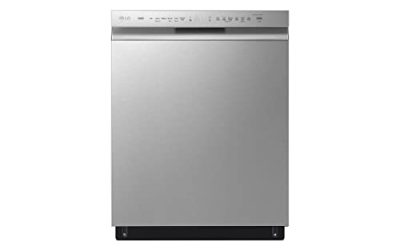
| Bosch 300 Series SHE53B75UC | B0BT5SJB1F | Best full-size built-in with a built-in softener |
| Kenmore 24″ Premium Hybrid Tub 2214789 | B0FMHFK6MR | Best for sandy, gritty well water |
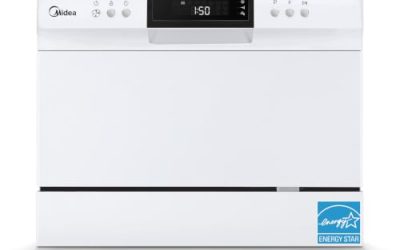
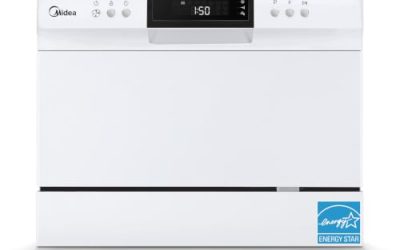
| AIRMSEN TDQR09 | B0FB3X2XSL | Best countertop with softener and tank feed |
| HAVA TDJR09 | B0DMS6821R | Best compact tank model with hardness-matched softener |
What matters most for well water homes
Sediment and sand filtration. Wells pull fine grit into the supply line, especially after heavy rain or pump work, and that grit clogs spray-arm holes and wears pump seals. Look for multi-stage filtration with a filter you can remove and rinse by hand, backed by an upstream sediment filter on the house line.
A built-in softener for mineral load. Hardness in well water is often higher and less consistent than city water. A salt-based softener inside the dishwasher exchanges calcium and magnesium for sodium, which cuts white film on glassware and scale on the heating element. It only works if you keep the salt dispenser filled and set the hardness level to your water, so an adjustable setting matters.
Tub material and iron staining. Iron and manganese oxidise inside a hot dishwasher and plate out as orange or brown staining. A stainless steel tub resists that staining and is easier to clean back than a plastic interior. A hybrid tub with a plastic floor sits in between: the walls shrug off stains, the floor needs more attention.
High-temperature wash and sanitize options. Private wells are not disinfected the way municipal water is, so a sanitize or high-temp cycle that holds a hot final rinse is worth having for baby bottles, chopping boards and sick-room dishes. Check that the option is named on the listing for the exact model.
Tolerance for pressure swings. A well pump cycles between cut-in and cut-out pressures, so inlet flow is less steady than city supply. Leak protection such as a contained inlet hose reduces the risk that a pressure surge or a failed hose turns into a flooded cabinet.
Maintenance you can actually do. On well water, filters need rinsing more often and spray arms need their holes checked for grit. Models with tool-free filter removal turn a quarterly chore into a two-minute one, which means it actually gets done.
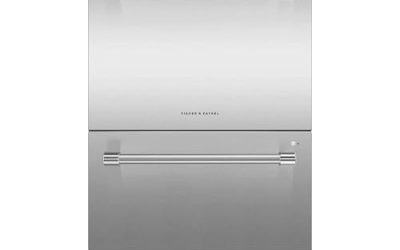
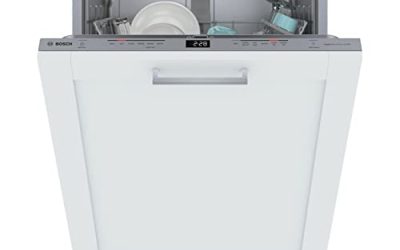
Bosch 300 Series SHE53B75UC
| Spec | Detail |
|---|---|
| Type | 24-inch built-in |
| Capacity | 15 place settings |
| Noise figure | 46 dBA |
| Wash cycles | 6 (Heavy, Auto, Normal, Speed60, Favorite, Rinse) |
| Water softener | Yes, salt-based, adjustable hardness setting |
| Tub material | Stainless steel |
| Third rack | Standard 3rd rack |
| Drying system | PureDry condensation drying |
| Sanitize option | Yes |
| Water use | 3.5 gallons per cycle |
| Energy use | 269 kWh per year |
| Dimensions | 23.56 x 22.56 x 34.06 inches |
| Weight | 90 lb |
| Connectivity | Home Connect Wi-Fi |
| Leak protection | 24/7 AquaStop Plus |
Why it fits well water. This is the rare full-size built-in sold on Amazon US whose listing and spec sheet both confirm a built-in water softener: Bosch lists “Water Softener: Yes” for the SHE53B75UC, with a dedicated salt dispenser and hardness settings you match to your supply. For a well with real mineral load, that is the most useful feature a dishwasher can carry, because it treats water at the point of use even if the house has no softener of its own. The stainless steel tub is the second reason: iron staining wipes off steel far more readily than it releases from plastic. PrecisionWash sensors adjust the wash to the soil level, the sanitize option answers the hygiene side of private-well life, and AquaStop Plus leak protection suits a pressurised well line feeding the machine around the clock.
Trade-offs. The softener is not fit-and-forget: it needs special dishwasher salt, and the hardness setting has to be dialled to your water or it under- or over-treats. A softener also does nothing for sediment, so this machine still wants a sediment filter upstream on the house line. PureDry is condensation drying, which leaves plastics wetter than fan-assisted systems. At 46 dBA it is quiet, but it is a full built-in install, so it suits a permanent kitchen rather than a temporary setup.
Best for / Skip if. Best for a family kitchen on a hard, mineral-heavy well that has no whole-house softener. Skip it if your well’s main problem is sand rather than hardness, or if you will not keep up with salt refills — an unfilled softener is just a feature you paid for and do not use.
Kenmore 24″ Premium Hybrid Tub Dishwasher (2214789)
| Spec | Detail |
|---|---|
| Type | 24-inch built-in |
| Capacity | 12 place settings |
| Noise figure | 54 dBA |
| Wash system | UltraWash, 2 pressurised spray arms |
| Filtration | 3-stage UltraWash filter |
| Sensor cycle | SmartWash soil sensor |
| Options | Sani Rinse, High Temp, Heated Dry, Express Wash, Delay Start |
| Tub material | Hybrid (stainless walls, plastic floor) |
| Rack | MoreSpace adjustable upper rack, removable |
| Energy use | 240 kWh per year |
| Dimensions | 23.6 x 22.6 x 33.7 inches |
| Weight | 68.95 lb |
| Handle | Pocket handle |
Why it fits well water. Where the Bosch answers mineral load, the Kenmore answers grit. Its UltraWash system pushes water through a 3-stage filter that Kenmore describes as catching particles as small as sand, exactly the contaminant that destroys dishwasher pumps on well systems and plugs spray-arm jets. SmartWash reads the soil level and adjusts temperature, pressure and time to match, and the Sani Rinse option gives you the high-temperature final rinse that matters when the supply is untreated. The filter sections lift out for rinsing at the sink, which on a sandy well is a monthly habit rather than an annual one.
Trade-offs. There is no built-in softener, so hardness minerals are handled only by detergent and rinse aid; on a hard well this model pairs best with a whole-house softener upstream. The hybrid tub’s plastic floor is the surface most likely to pick up iron staining. At 54 dBA it is noticeably louder than the Bosch, and 12 place settings is a smaller load than the 15-setting machines here.
Best for / Skip if. Best for wells that run sandy or gritty, and for households that would rather rinse a filter monthly than manage softener salt. Skip it if your water is hard but clear and your house has no softener — the Bosch above treats that water better.
AIRMSEN TDQR09 Countertop Dishwasher
| Spec | Detail |
|---|---|
| Type | Countertop, built-in tank or faucet hookup |
| Tank capacity | 5 litres (1.3 gallons) |
| Water softener | Integrated, adjustable hardness settings, uses dishwasher salt |
| Programs | 8, including Strong, ECO, Speed, Glass, Fruit and Self-Clean |
| Max wash temperature | 167 degrees F |
| Drying | Hot air drying, extended air circulation with Dry+ |
| Delay start | 1 to 18 hours |
| Child lock | Yes |
| Dimensions | 16.73 x 16.85 x 18.03 inches |
| Weight | 31.7 lb |
| Energy use | 105 kWh per year |
| Power | 950 W, 110 V |
| Noise figure | About 50 dB |
| Plate size | Up to 10.24 inches |
Why it fits well water. The TDQR09 carries its water treatment in a box that sits on the counter: the listing names an integrated water softener among its special features, with hardness settings you adjust to your supply and a salt reservoir to keep filled. The tank feed is the second well-water advantage. Filling the 5-litre tank by hand means you can use water that has already passed a jug or under-sink filter, keeping raw well sediment out of the machine entirely, while the faucet hose stays available for everyday use. The Self-Clean program helps flush mineral deposits from the interior, and the 167-degree top temperature covers the hygiene angle for untreated water. No installation is needed, which suits a well-served cabin, granny flat or rental where a built-in is not possible.
Trade-offs. Capacity is the ceiling: the tank needs refilling for every load and plates top out at 10.24 inches, so family-size dinners mean two runs. The softener needs the same salt discipline as the Bosch in miniature. Hot-air drying runs after most cycles, which adds time, and at about 50 dB it is audible in a small open-plan space.
Best for / Skip if. Best for small households, cabins and rentals on wells with hard water and no dishwasher plumbing. Skip it if you regularly wash full-size dinner plates and serving platters, or if a permanent built-in is already plumbed in your kitchen.
HAVA TDJR09 Countertop Dishwasher
| Spec | Detail |
|---|---|
| Type | Countertop, built-in tank or faucet hookup |
| Tank capacity | 5 litres |
| Water softener | Built in, setting matched to water hardness |
| Programs | 8 wash programs |
| Controls | Touch screen |
| Delay start | Up to 18 hours |
| Child lock | Yes |
| Dimensions | 16.86 x 16.75 x 18.05 inches |
| Weight | 28.6 lb |
| Energy use | 150 kWh per year |
| Noise figure | About 60 dB |
Why it fits well water. The HAVA’s softener works the same way as the AIRMSEN’s — a salt-fed unit inside the machine — but its control is a hardness setting you match to your water, which suits wells whose mineral content sits at the high end and needs a stronger setting than the default. The 5-litre tank again lets you choose what goes into the machine: fill from a filtered tap and sediment in the raw well line never reaches the pump. Eight programs, an 18-hour delay and a child lock round out an unusually complete spec for a machine this size, and at 28.6 lb it moves between counter, utility room and cabin without help.
Trade-offs. Read the listing’s voltage line carefully before ordering: a 220-volt figure has appeared in this listing’s details, so confirm you are ordering the correct version for a US outlet. It is also the loudest machine here at about 60 dB, loads are small at three place settings, and like every countertop here it drains to a sink rather than a plumbed waste line.
Best for / Skip if. Best for one- or two-person households on hard well water who want a softener and tank feed in the smallest footprint. Skip it if the voltage on the listing does not match your supply, or if noise matters in a studio layout — the AIRMSEN runs far quieter.
How to choose between these picks
Start by naming your well’s main problem, because each pick answers a different one. If white crust builds up in your kettle and glasses come out filmed, your issue is mineral load: choose a softener model, the Bosch for a full-size kitchen or the AIRMSEN for a countertop. If your water runs cloudy after rain and grit collects in faucet aerators, your issue is sediment: the Kenmore’s 3-stage filter is built for that water. If your water stains the sink orange, iron is the issue; no dishwasher removes iron, so favour the stainless tub of the Bosch and plan house-level iron treatment separately. Finally, match the format to the building: built-ins for a plumbed kitchen you own, tank-fed countertops for rentals, cabins and outbuildings.
Setup and care on well water
Protect the inlet first. Fit a sediment filter on the house line before the dishwasher if you do not already have one, and check the small inlet screen where the hose meets the machine every few months; on a well it collects the grit that would otherwise reach the pump.
Set the softener to your water. A softener only earns its keep when the hardness setting matches a real test figure. Test the well water with a strip or lab sample, set the machine to that band, and keep the salt dispenser topped up — an empty dispenser means hard water passes through untreated.
Rinse filters on a well schedule. Ignore the city-water habit of checking the filter twice a year. On well water, lift the filter out monthly, rinse it under the tap and look for sand sitting in the sump. Do the same for spray-arm holes: a toothpick clears grit from a blocked jet in seconds.
Watch for iron and scale. Orange staining points to iron the softener cannot fully handle; a citric-acid dishwasher cleaner run on an empty hot cycle clears early buildup. White scale on the heating element means the softener setting is too low for your water or the salt has run out.
Mind the pump and pressure. After any well pump service or pressure-tank work, run a tap until the water runs clear before the next wash, so stirred-up sediment goes down the sink instead of into the dishwasher.
FAQ
Does a built-in dishwasher softener remove iron and sediment from well water?
No. A dishwasher softener exchanges hardness minerals — calcium and magnesium — for sodium. It does not filter out sand or sediment, and it only reduces iron’s effects; meaningful iron removal needs treatment equipment on the house line. Choose the dishwasher for how it tolerates your water, and treat the water itself upstream.
Do I still need a whole-house filter if the dishwasher has a softener?
For sediment, yes. Grit is the main mechanical threat to a dishwasher on a well, wearing pump seals and blocking spray arms, and a softener does nothing to stop it. A sediment filter ahead of the machine protects every appliance on the line.
Why do dishes and the tub turn orange in my well-water home?
That is iron, often with manganese, oxidising in hot water and settling on surfaces. A stainless steel tub resists the staining and cleans back more easily than plastic. A softener reduces how much iron reaches the tub, but persistent staining means the well needs iron treatment at the house level.
How often should I clean the filter on well water?
Monthly is a sensible rhythm for most wells, and sooner after any pump work, heavy storms or if washes start leaving grit on glasses. All four picks here have filters or screens you can rinse at the sink without tools or a service visit.
Can a countertop dishwasher work in a house on well water?
Yes, and the tank-fed models here have a genuine advantage: you can fill the tank with water from a filtered tap, so sediment never enters the machine. Models with a built-in softener also handle hardness. The limits are capacity and refilling the tank each load, not the water source.
Conclusion
For a permanent kitchen on a hard well, the Bosch SHE53B75UC is the clearest recommendation: a confirmed built-in softener and a stainless tub answer the two problems well water causes most. If your well runs sandy rather than hard, the Kenmore 2214789 and its 3-stage filter is the better tool, ideally behind a house sediment filter. For small spaces and unplumbed buildings, the AIRMSEN TDQR09 pairs a softener with a tank you can fill with filtered water, while the HAVA TDJR09 suits one or two people who need the hardness-matched softener in the smallest body — just confirm the voltage on its listing first. The pattern is the same either way: treat sediment at the house line, let the machine handle hardness and hygiene, and keep filters on a well-water schedule.