Our Short List of 3
All 3 Picks at a Glance
| Product | Specs | Action |
|---|---|---|
 COMFEE’ CDC22P2AWW Countertop Dishwasher | Check price on Amazon | |
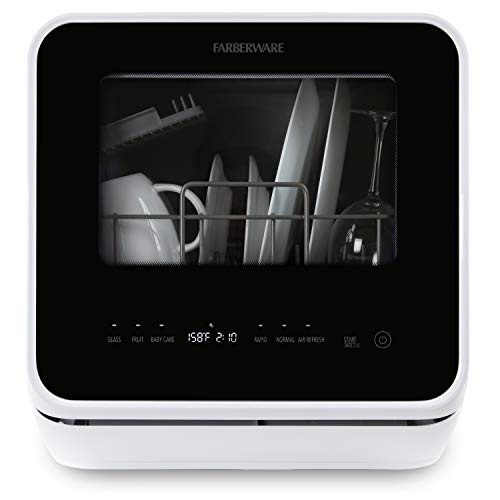 Farberware FDW05ASBWHA Complete Portable Countertop Dishwasher | Check price on Amazon | |
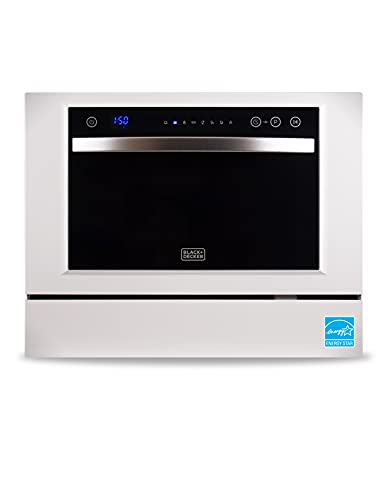 BLACK+DECKER BCD6W Compact Countertop Dishwasher | Check price on Amazon |
Key takeaways
- Compare the best dishwashers under 300 for small kitchens: countertop picks checked on capacity, cycles, dimensions, water supply and setup needs today.
Shopping at the lowest-cost end of the dishwasher market means being honest about format first. Full-size built-in machines are not positioned in this band, so every realistic pick here is a countertop model: a compact unit that sits on the counter, connects to a faucet or fills from an internal tank, and washes a small load without any plumbing work or cabinet changes. That format suits renters, dorm rooms, small apartments, RVs and anyone adding a second wash point in a tight kitchen. This guide compares three countertop dishwashers positioned at this entry end of the market, and it is written for buyers who would rather give up capacity than give up a machine entirely. The picks are based on manufacturer specifications and Amazon listing details for each exact model, cross-checked against the makers’ published figures.
Disclosure: As an Amazon Associate, we earn from qualifying purchases. Product details and availability can change; check the Amazon listing before you buy.
Quick picks at a glance
| Product | ASIN | Best for |
|---|---|---|
| COMFEE’ CDC22P2AWW Countertop Dishwasher | B096RYWSQM | The most complete cycle set in a 6 place setting countertop body |
| Farberware FDW05ASBWHA Complete Portable Countertop Dishwasher | B07VR22832 | No-hookup use, thanks to its built-in water tank |
| BLACK+DECKER BCD6W Compact Countertop Dishwasher | B0773QXFH3 | A stainless steel interior and a delay start timer |
What matters most at this end of the market
Format reality. In this band the choice is not between brands of built-in machines; it is between countertop designs. Accepting that early saves time: every pick below trades load size for a low entry cost, zero installation work and the freedom to take the machine with you when you move.
Water supply: tank or faucet. Tank models fill by hand from a pitcher and can run anywhere with an outlet and a drain point, which suits dorms and RVs. Faucet models connect to the kitchen tap with a quick-connect adapter and draw water on demand, which suits a fixed spot in a home kitchen but ties up the faucet while a cycle runs.
Capacity in place settings. Countertop machines in this band hold either about two place settings or about six. Two settings means one person’s plates, bowls and cutlery per run; six settings covers a couple or a small household’s daily dishes. Plate diameter limits matter too, since most countertop interiors accept plates up to about 10 to 12 inches.
Counter clearance. These machines are roughly 17 inches tall, which fits under most upper cabinets, but the width and depth differ by several inches between models. Measure the counter footprint and the gap to your cabinets before choosing, and leave room behind the unit for hoses.
Cycle set and drying. Entry models still vary a lot here: some offer a handful of programs, others add baby-care, glass and rapid cycles, plus an extra-drying function. If you wash bottles, stemware or plastic containers often, the cycle list matters more than raw capacity.
Running costs. Annual energy consumption figures for these compact machines are modest, and water use per cycle is a few gallons at most. A model with an eco program and a low per-cycle water figure keeps ongoing costs in line with the low purchase positioning.
COMFEE’ CDC22P2AWW Countertop Dishwasher
Why it fits this band. The COMFEE’ is the most fully featured of the three picks: eight programs is a long list for an entry-level countertop machine, and it includes the cycles small households actually rotate through, from a 45-minute Speed wash to Baby-Care and Glass. It holds up to 70 pieces of tableware with plates up to 10 inches, and an extra-drying function helps plastic items come out drier than air drying alone.
Trade-offs. It needs a faucet connection, so it cannot run in a room without a suitable tap, and at 46 pounds it is a lift-two-people-or-slide-it weight rather than something you move daily. The faucet is occupied while it runs.
Best for / Skip if. Best for couples and small households that want one fixed countertop machine with a real choice of cycles. Skip it if you have no compatible faucet or need a machine that can run away from the sink.
Farberware FDW05ASBWHA Complete Portable Countertop Dishwasher
Why it fits this band. The Farberware removes the biggest barrier at this end of the market: plumbing. Its built-in 5-liter tank fills with the included pitcher, so it can wash in a dorm room, an RV, a boat or a rental where the faucet cannot be adapted. It is also the lightest and narrowest pick here, and the only one with a fruit wash program alongside baby care and glass cycles. Despite the small body, it accepts dishes up to 12 inches across, larger than the plate limit of the six-setting models.
Trade-offs. Two place settings is a hard ceiling: this is one person’s dishes per run, and the tank needs refilling for back-to-back loads. The interior and racks are plastic rather than stainless steel.
Best for / Skip if. Best for single occupants, students and RV users who need a machine that works with no hookup at all. Skip it if you cook for two or more people every day, because the small capacity will mean constant cycling.
BLACK+DECKER BCD6W Compact Countertop Dishwasher
Why it fits this band. The BLACK+DECKER matches the COMFEE’ on capacity but adds a stainless steel interior, which resists staining and odors better over years of use, and a delay start of up to 24 hours so a load can be set to run overnight or while you are out. The seven programs include a Soak option for dried-on food and a 90-minute cycle between rapid and intensive, giving more mid-range choices than most entry models.
Trade-offs. Like the COMFEE’, it is faucet-only with no tank option, and it is the widest machine here at 21.7 inches, so check your counter run carefully. Plates are limited to about 10 inches.
Best for / Skip if. Best for small households that want the durability of a stainless interior and the convenience of a delayed start. Skip it if your counter is narrow or you need the freedom of a tank-fed machine.
How to choose between these picks
Start with water. If your sink faucet cannot take an adapter, or the machine needs to live away from the sink, the Farberware is the only pick that works, because its tank removes the connection question entirely. If a faucet connection is fine, choose on capacity and interior: the COMFEE’ and the BLACK+DECKER both hold six place settings, so the decision becomes cycle breadth versus build. Pick the COMFEE’ if baby-care and mini-party programs match your loads and you want the longest program list; pick the BLACK+DECKER if a stainless steel tub and a 24-hour delay start matter more. Finally, measure: all three are about 17.2 inches tall, but widths run from 16.5 to 21.7 inches, and that difference decides which one actually fits your counter.
Setup, daily workflow and care
Setup for the faucet models means fitting the quick-connect adapter to your tap, attaching the inlet and drain hoses, and placing the drain hose so it empties into the sink without kinks. For the Farberware, setup is filling the tank with the pitcher and positioning the drain hose the same way. Before the first run, confirm the machine sits level, since a tilted countertop unit can drain poorly. In daily use, scrape plates rather than rinsing them, load cutlery handles-up in the basket, and keep large items from blocking the spray arm’s rotation. Run a hot empty cycle with a dishwasher cleaner periodically, wipe the door seal weekly, and clean the filter under the lower rack on a regular schedule, because compact machines with small filters lose cleaning performance quickly when the filter clogs. If your water is hard, a rinse aid helps prevent spots on glassware, and the glass program on any of these picks runs cooler to protect stemware.
FAQ
Can a dishwasher in this band really replace hand washing for a household?
For one or two people, yes, provided loads are run daily. The six place setting models handle a small household’s everyday dishes, while the two place setting Farberware covers a single person’s meals. Larger families would need to run several cycles a day, which erases the convenience.
Do these machines need a special faucet?
The faucet models connect with a quick-connect adapter included in the box, and they fit most standard threaded faucets. Faucets with pull-out sprayers or unusual shapes may not accept the adapter, which is exactly the situation the tank-fed Farberware is built for.
How much counter space do they actually need?
Plan on a footprint between about 16.5 and 21.7 inches wide and roughly 17.2 inches of vertical clearance under upper cabinets, plus a few inches behind for hoses. Measure before ordering, because width is the dimension that varies most between these picks.
What size plates fit inside?
The six place setting models accept plates up to about 10 inches in diameter. The smaller Farberware, despite its lower place setting count, fits dishes up to 12 inches across because of its rack layout, which can matter if your everyday plates are oversized.
Are they expensive to run?
No. Annual energy consumption figures run from 130 to 174 kilowatt hours per year across these three models, and water use is only a few gallons per cycle, far less than washing the same load by hand under a running tap.
Conclusion
At this end of the market, the right question is not which brand to buy but which water supply and capacity fit your space. Choose the Farberware FDW05ASBWHA if you need a machine that runs with no hookup at all, in a dorm, RV or awkward rental sink setup. Choose the COMFEE’ CDC22P2AWW if you have a faucet to connect to and want the widest program choice for a couple’s daily dishes. Choose the BLACK+DECKER BCD6W if you want the same capacity with a stainless steel interior and a delay start that lets the machine run on your schedule. All three keep the entry cost low by staying compact, and each one is a clear step up from a permanently full sink.