Our Short List of 3
All 3 Picks at a Glance
| Product | Specs | Action |
|---|---|---|
 LG LDTH7972S | Check price on Amazon | |
 Samsung DW80B6060UG/AA | Check price on Amazon | |
 Sharp SDW6757ES | Check price on Amazon |
Key takeaways
- The best auto dishwashers let soil sensors set the wash for you. Compare four sensor-driven Auto cycles on specs, noise levels, racks and drying systems.
An auto dishwasher is built around one idea: instead of guessing which cycle a load needs, the machine measures how dirty the wash water is and sets the cycle itself. A soil sensor — usually a turbidity sensor that shines light through the water in the sump — reads how much food soil is suspended in the first rinse, and the control board then adjusts wash time, water temperature, water volume and sometimes spray intensity to match. Lightly soiled glasses get a shorter, cooler, gentler wash; a load of sauce-covered pans gets a longer, hotter one, all from the same Auto button.
This guide is for households that run mixed loads most days and would rather press one button than study a cycle chart. Every pick below has a genuine sensor-driven Auto cycle as its headline program — not a fixed “normal” cycle with a marketing name — and each was checked against its Amazon US listing and the maker’s own documentation for that exact model. The four machines take different approaches to the same job: LG pairs its sensor with steam and heated drying, Samsung adds a high-pressure jet zone and door-open drying, Bosch combines sensor wash control with a built-in water softener, and Sharp keeps the formula simpler with sensor-adjusted time and temperature plus a heated dry.
Disclosure: As an Amazon Associate, we earn from qualifying purchases. Product details and availability can change; check the Amazon listing before you buy.
Quick picks at a glance
| Product | ASIN | Best for |
|---|---|---|
| LG LDTH7972S | B0BX7FHNYM | The most complete sensor package, with steam and the quietest run |
| Samsung DW80B6060UG/AA | B0B9GHTQ1F | Auto sensing plus a high-pressure jet for pots and casseroles |
| Bosch 300 Series SHE53B75UC | B0BT5SJB1F | Sensor wash control with a built-in water softener for hard water |
| Sharp SDW6757ES | B08GFP9ZS7 | Straightforward sensor Auto with heated dry and a power wash zone |
What matters most when the machine chooses the cycle
How the sensor reads the load. All four picks use a turbidity-style soil sensor: early in the cycle the machine flushes the load, then measures how cloudy that water is. The reading drives everything that follows. This is why scraping matters more than rinsing — the sensor can only judge the soil that actually reaches the water, and it calibrates the whole wash from that sample.
What Auto is allowed to change. A strong Auto program adjusts at least three variables: cycle length, wash temperature and water volume. Better implementations also decide whether to add a prewash or an extra rinse. When you compare spec sheets, look for a published cycle-time range on Auto rather than a single fixed time — a wide range is evidence the program genuinely adapts instead of running one preset.
The wash system behind the sensor. Sensing only decides the recipe; spray arms still do the work. Multi-arm systems and dedicated jet zones (LG’s QuadWash Pro, Samsung’s StormWash+ rotating jet, Sharp’s Power Wash zone, Bosch’s PrecisionWash spray pattern) give the Auto program more to work with when it detects heavy soil and extends the wash.
Drying is a separate decision. Auto cycles end in very different places: heated dry (Sharp), fan-and-heat dry (LG’s Dynamic Heat Dry), door-open air dry (Samsung’s AutoRelease Door) or condensation drying (Bosch). Plastics and storage containers are the real test items, so match the drying system to what your household loads most.
Noise figure. Sensor machines are run more often and at more hours of the day, including overnight, so the published decibel figure matters. The picks here span 42 to 46 dBA — all quiet enough for open-plan kitchens, with the LG the softest of the four.
Sensor upkeep. A coated or dirty filter skews soil readings and can make Auto under-wash or over-wash. Models differ in filter access and self-clean programs, and the care section below covers the routine that keeps the sensor honest.
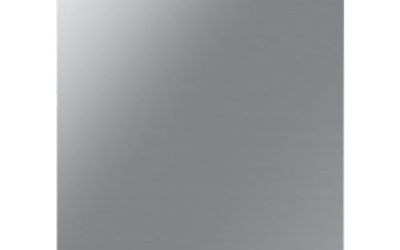
LG LDTH7972S
Why it fits the auto brief. LG’s SenseClean system is the most explicit sensor implementation in this group: the turbidity sensor measures soil in the water and the Auto cycle re-plans time and water use around that reading, rather than stepping through a fixed script. Around that core, the LDTH7972S layers the strongest supporting hardware here — QuadWash Pro’s high-pressure jets, TrueSteam for loosening dried-on residue before the main wash, and a 1-Hour Wash and Dry program for the days when Auto’s measured approach is more than the load needs.
Trade-offs. The feature set is deep enough that the top-control panel and ThinQ app take some learning, and steam plus heat dry make this the most complex machine in the guide to use to its full extent. Buyers who want a single button and nothing else to think about may find the Sharp simpler to live with.
Best for / Skip if. Best for households that run varied loads daily and want the sensor to have the most wash and dry hardware to command. Skip if you prefer front controls or never use app-connected features.
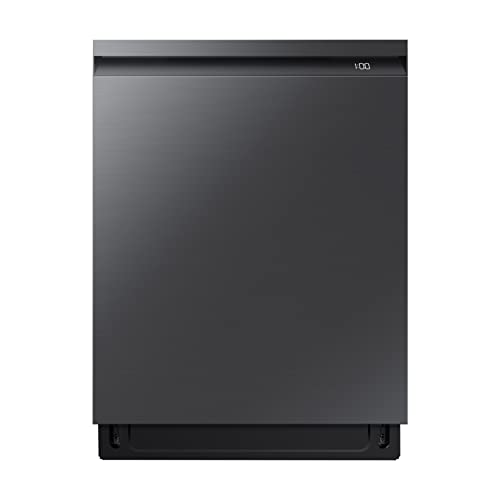
Samsung DW80B6060UG/AA
Why it fits the auto brief. Samsung states the Auto behaviour plainly in its manual: the cycle detects the level of soil and automatically initiates the optimal cycle after a few minutes of operation, and whether the prewash and rinse stages run at all depends on the soil level the sensor finds. That is true adaptive logic, and it is backed by the StormWash+ system — dual arms plus a rotating jet that blasts at high pressure — for the loads where the sensor decides to work harder. The AutoRelease Door then opens at the end of the cycle to circulate air, which suits plastics better than sealed condensation drying.
Trade-offs. The drying depends on the door opening, so loads left closed for hours after the cycle ends benefit less. The control scheme leans on the SmartThings app for extras such as downloadable cycles, which will not suit buyers avoiding app ecosystems.
Best for / Skip if. Best for families whose loads swing between light breakfast dishes and heavy cookware, and who want the sensor paired with a real jet system. Skip if you want heated drying rather than door-open air drying.
Bosch 300 Series SHE53B75UC
| Spec | Detail |
|---|---|
| Auto system | Auto program with PrecisionWash intelligent sensors that monitor soil and adjust the wash |
| Wash cycles | 6 |
| Noise figure | 46 dBA |
| Place settings | 15 |
| Drying | PureDry condensation drying |
| Water treatment | Built-in water softener |
| Energy use | 269 kWh per year |
| Power | 1440 W, 120 V |
| Weight | 90 lb |
| Connectivity | Home Connect Wi-Fi |
Why it fits the auto brief. Bosch’s PrecisionWash uses intelligent sensors to assess soil levels and scan throughout the cycle, adjusting spray pressure and water use as conditions change rather than committing to a single reading at the start. The SHE53B75UC adds the one feature none of the other picks offer: a built-in water softener. In hard-water homes that matters twice over for an auto machine, because mineral film on dishes and on the sensor itself degrades both results and readings over time. Home Connect adds remote monitoring and cycle alerts on top.
Trade-offs. At 46 dBA it is the loudest of the four, though still in the quiet class for a full-size built-in. Drying is condensation-based, so plastics come out less dry than with the heated or door-open systems here, and the softener needs salt refills as routine upkeep.
Best for / Skip if. Best for hard-water households that want sensor washing without limescale slowly undoing it. Skip if overnight silence is the top priority or you dry a lot of plastic containers.
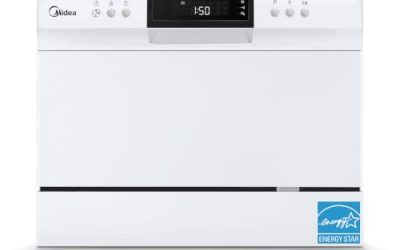
Sharp SDW6757ES
Why it fits the auto brief. Sharp describes its Auto cycle in the most direct terms in this guide: it automatically adjusts time and wash temperature based on soil sensors. There is no app layer and no steam system — the sensor, a Power Wash zone with a dedicated sprayer for concentrated soil, smooth-glide racks and a traditional heated dry carry the whole proposition. For buyers who like the auto concept but not feature sprawl, this is the cleanest expression of it.
Trade-offs. Capacity is a touch smaller at 14 place settings, and the sensor adjusts fewer variables than the LG’s system — time and temperature rather than the full recipe. The control panel is hidden on the top edge, which keeps the door face clean but means checking cycle progress mid-wash is less immediate.
Best for / Skip if. Best for buyers who want set-and-forget washing with heated dry and no smart features to manage. Skip if you need the full 15-place-setting capacity or want app control.
How to choose between these picks
Start with your water. If your home has hard water, the Bosch’s built-in softener protects both the dishes and the sensor, and it becomes the default recommendation despite the higher noise figure. If your loads are the most varied — cereal bowls one night, a roasting pan the next — the LG’s SenseClean system has the deepest sensor implementation and the most wash hardware behind it, and its 42 dBA figure makes it the easiest to run overnight. Choose the Samsung if cookware dominates: the StormWash+ jet is the strongest targeted cleaning tool here, and its Auto program decides prewash and rinse stages from the soil reading rather than running them by default. Choose the Sharp if you want the auto behaviour with the least technology wrapped around it — sensor-adjusted time and temperature, heated dry, and a control scheme that never asks for your phone.
Getting the best from an Auto cycle: loading and care
Scrape, do not pre-rinse. The sensor judges the load from the soil that reaches the wash water. Dishes rinsed clean under the tap can make Auto read a light load and shorten the wash, leaving the remaining soil on pans under-washed. Scrape solids into the bin and load everything else as it is.
Keep the sensor’s sample honest. Load so that water circulates freely to the sump: bowls angled to drain, no large tray blocking the spray path to the lower rack, and cutlery spread rather than nested. A blocked spray arm corrupts the soil sample the whole cycle is planned around.
Clean the filter on schedule. Every pick here has a removable filter system, and a clogged filter both reduces wash pressure and distorts turbidity readings. Rinse it monthly under the tap, and run the machine’s self-clean or Machine Clean program (named on the LG and available as a downloadable cycle on the Samsung) with the tub empty.
Use rinse aid. It improves drying on every system represented here and helps water sheet off surfaces instead of beading, which also keeps the sensor window clearer between services. On the Bosch, keep the softener salt topped up as well — the manual flags the refill indicator for a reason.
FAQ
How does an Auto cycle actually decide how dirty the load is?
A turbidity sensor in the sump measures how cloudy the water becomes during the first minutes of washing. The control board converts that reading into a soil level and then sets wash time, temperature and water volume for the rest of the cycle. Samsung describes its Auto program as detecting the soil level and initiating the optimal cycle after a few minutes of operation; LG’s SenseClean and Bosch’s PrecisionWash work on the same principle.
Is Auto always the most efficient program to run?
For a typical mixed load, usually yes, because it avoids running a full heavy program for light soil or wasting a second wash on a load a fixed normal cycle under-cleaned. For a handful of lightly soiled items, a short express program can use less water and time. Auto earns its keep on the full, varied loads most households run daily.
Why does the same Auto cycle take much longer on some days?
That variation is the system working as designed. Heavy soil readings extend the wash, raise temperatures and can add rinse stages, while light loads finish far sooner. LG publishes a wide time range for its Auto cycle for exactly this reason. If times suddenly lengthen for ordinary loads, check the filter first — a clogged filter distorts the sensor’s sample.
Can Auto handle baked-on pans, or should I still use Heavy?
Auto will extend itself when it senses heavy soil, and jet-equipped models like the Samsung and Sharp aim extra pressure at the worst items. For carbonised roasting trays and casserole dishes, a dedicated Heavy program still applies maximum temperature and duration from the outset, so keep it for the worst loads and let Auto cover everything else.
Do sensor dishwashers need any special maintenance?
Only one addition to the usual routine: protect the sensor’s accuracy. Keep the filter clean, use rinse aid, and descale if your water is hard — or choose a model with a built-in softener, like the Bosch here, which handles that itself.
Conclusion
If you want one recommendation per kitchen: the LG LDTH7972S is the most complete auto dishwasher here, pairing the deepest sensor system with steam, heated drying and the lowest noise figure. The Samsung DW80B6060UG/AA is the pick for cookware-heavy homes, where the StormWash+ jet gives the sensor’s decisions real force. The Bosch SHE53B75UC is the hard-water answer, with PrecisionWash sensing and a built-in softener in one machine. And the Sharp SDW6757ES is the straightforward choice — sensor-adjusted washing and heated dry, without the smart layer. All four let the machine read the load and set the wash; they differ in what that decision can call on, and in how the dishes dry when it is done.