Key takeaways
- The best two drawer dishwashers split mixed loads across two fully independent drawers, so pots, glassware and daily dishes each get the right wash cycle.
A standard dishwasher forces every load into one compromise: the roasting pan, the wine glasses and the breakfast bowls all share a single tub and a single wash program. Two drawer dishwashers remove that compromise. Each unit holds two fully independent drawers in one standard 24-inch opening, and each drawer has its own wash system, its own program selection and its own racking. That layout is built for flexibility with mixed load sizes: a small drawer of glasses can run a delicate cycle while the other drawer takes a heavy load of pots, or a half load of lunch dishes can wash on its own without waiting for a full tub to accumulate.
This guide is for households whose dish loads rarely arrive in one uniform size — families that cook a big dinner but snack all day, entertainers who generate glassware in bursts, and anyone who finds a full-size tub either half empty or awkwardly overpacked. The picks below are based on manufacturer specifications and Amazon listing details for each exact model. One honest note up front: two-drawer dishwashers on Amazon US are effectively a one-brand category. Fisher & Paykel created the DishDrawer format and remains the only maker with verifiable Amazon US listings for double-drawer machines, so this guide runs with the two models that verify rather than padding the list with unverified alternatives.
Disclosure: As an Amazon Associate, we earn from qualifying purchases. Product details and availability can change; check the Amazon listing before you buy.
Quick picks at a glance
| Product | ASIN | Best for |
|---|---|---|
| Fisher & Paykel DD24DAX9 N Double DishDrawer (Series 7 Contemporary) | B07DM73CX5 | Everyday mixed loads in a standard-height opening |
| Fisher & Paykel DD24DV2T9 Double DishDrawer (Series 9 Professional Tall) | B07GSDDXJV | Taller items in the top drawer and extra wash options |
What matters most for mixed load sizes
Independent drawers, genuinely independent cycles. The whole point of the format is that each drawer runs its own program at its own time. Check that the model lets both drawers run simultaneously on different programs — both picks here do — because that is what lets a delicate glass load and a heavy pot load finish in the same evening without either one dictating the cycle.
Drawer height and plate clearance. Two drawers split a standard opening, so each drawer is shallower than a full tub. Standard-height drawers suit dinner plates and everyday bowls; tall-drawer variants add clearance in the top drawer for larger plates and serving pieces. Measure your largest plates before choosing, because oversized platters are the format’s main physical limit.
True half-load behaviour. Each drawer holds a true half load — seven place settings on both picks here — so running one drawer for a small load uses roughly half the water and energy of the pair. If your household produces several small loads a day, this matters more than total capacity.
Racking that adapts per drawer. Fold-down tines, foldable cup racks and pitch-adjustable tines let one drawer cradle stemware while the other swallows a stockpot. Flexible racking is what turns two small tubs into a genuinely mixed-load system rather than two identical small ones.
Water and energy figures for both tubs. Manufacturers quote consumption for both drawers running together. Compare those combined figures, and remember a single-drawer run uses about half — relevant if you plan to run one drawer far more often than both.
Noise in open-plan kitchens. Drawer machines sit at bench height and run close to where people stand and talk. Both picks quote a noise figure in the low 40s dBA on the standard cycle, which suits evening runs in combined kitchen and living spaces.
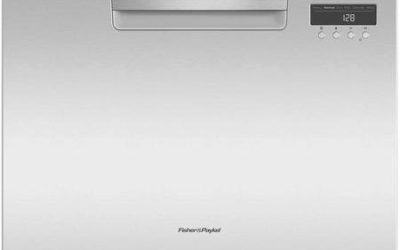
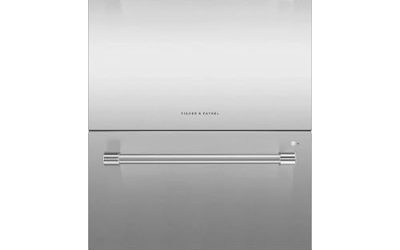
Fisher & Paykel DD24DAX9 N Double DishDrawer (Series 7 Contemporary)
| Spec | Detail |
|---|---|
| Configuration | Two independent drawers, built-in |
| Place settings | 14 total, 7 per drawer |
| Dimensions (H x W x D) | 32 5/16 to 34 5/8 x 23 9/16 x 22 9/16 in |
| Wash programs | 6 per drawer |
| Water use | 3.44 gal per cycle, both tubs running |
| Energy use | 265 kWh per year, Energy Star certified |
| Noise | 43 dBA on standard cycle, top drawer |
| Drying | Fan assisted |
| Controls | Touch, with keylock and child lock |
| Extras | Cutlery basket included, fold-down tines, foldable cup racks, delay start, ADA compliant |
| Supply | 120 V, 60 Hz |
| Warranty | Limited 2 years, parts and labor |
Why it fits mixed load sizes. The DD24DAX9 N is the standard-height double drawer, and its flexibility comes from how differently the two drawers can be set up. Fold-down tines and foldable cup racks in each drawer mean one drawer can be flattened out for pots and mixing bowls while the other keeps its cup racks up for glasses and mugs. Six wash programs per drawer, running independently, cover the realistic spread of a mixed household load: Heavy for bakeware, Delicate for glassware, plus fast and eco options for the small in-between loads that a full tub handles badly. Each drawer is a true half load, so a drawer of lunch dishes is a complete, efficient wash rather than a guilty partial one.
Trade-offs. Standard-height drawers cap plate size below what a tall tub swallows, so very large platters and tall stockpots may still go to the sink. Six programs is a shorter menu than the Series 9 model below, and the combined water figure when both tubs run is the higher of the two picks here. The stainless Contemporary front is the only finish direction for this configuration.
Best for / Skip if. Best for households that run several varied loads a day in a standard-height opening and want the simpler, proven configuration. Skip it if your everyday plates are oversized or you regularly wash tall items — the tall top drawer of the DD24DV2T9 fits that pattern better.
Fisher & Paykel DD24DV2T9 Double DishDrawer (Series 9 Professional Tall)

| Spec | Detail |
|---|---|
| Configuration | Two independent drawers, built-in, tall top drawer |
| Place settings | 14 total, 7 per drawer |
| Dimensions (H x W x D) | 34 to 36 3/8 x 23 9/16 x 22 9/16 in |
| Wash programs | 6 per drawer, plus Quick, Sanitize and Extra Dry modifiers |
| Water use | 3.28 gal per cycle, both tubs running |
| Energy use | 263 kWh per year, Energy Star certified |
| Noise | 42 dBA on standard cycle, top drawer |
| Drying | Fan assisted, with Extra Dry modifier |
| Controls | Touch, internal wash selector, keylock, Wi-Fi connectivity |
| Extras | Cutlery basket included, fold-down and pitch-adjustable tines, knife clip, delay start, ADA compliant |
| Supply | 110 to 120 V, 60 Hz |
| Warranty | Limited 2 years, parts and labor |
Why it fits mixed load sizes. The DD24DV2T9 stretches the two-drawer idea in the direction mixed loads actually need: height where the big items go. The tall top drawer takes larger dinner plates and taller dishes that standard drawers refuse, while the lower drawer handles the everyday stack. The three wash modifiers widen the split further — add Sanitize to a drawer of chopping boards and baby items (the maker states the option kills 99.9 percent of bacteria in the final rinse), Quick to a drawer of glasses needed again the same evening, or Extra Dry to a drawer heavy on plastics. Pitch-adjustable tines and a knife clip give the racking more positions to work with, and Wi-Fi connectivity lets a drawer be started or checked from another room, which suits the staggered, load-by-load rhythm this format encourages.
Trade-offs. The taller cabinet needs the taller opening — at up to 36 3/8 inches high it does not fit every standard cutout, so the opening height must be checked before ordering. It is the more complex machine of the two, with more modifiers to learn, and the per-drawer plate limit still applies to the lower drawer.
Best for / Skip if. Best for entertainers and larger households whose mixed loads include big plates and serving pieces, and for anyone who wants the sanitize and quick modifiers for splitting loads by soil type. Skip it if your cutout is strictly standard height or you prefer the simplest possible control scheme.
How to choose between these picks
Start with your opening. If the cutout is a standard dishwasher height, the DD24DAX9 N is the fit; if you have the extra height — or are planning cabinetry around the machine — the DD24DV2T9’s tall top drawer earns its space the first time a large dinner plate goes in without tilting.
Next, look at what your mixed loads actually mix. If the split is mostly everyday dishes in one drawer and pots in the other, six programs and flexible tines cover it, and the Series 7 model is enough. If the split is by soil and hygiene — boards and baby gear needing a sanitize rinse, plastics needing extra drying, glasses needing a quick turnaround — the Series 9 modifiers do work the base programs cannot.
Finally, think about rhythm. Both machines reward households that wash little and often. If your pattern is one very large load after a weekly family dinner, a conventional full tub still holds more in a single cycle; the drawer format wins when loads arrive in different sizes across the day.
Installation, workflow and care
Both models install into a 24-inch wide opening with a standard water supply, drainage and a 120-volt connection, and both are designed to sit at bench height so loading happens with minimal bending. The DD24DV2T9’s taller frame needs its opening height confirmed against the installation guide before purchase. Because the drawers seal with a lid that closes onto the tub at cycle start, items must sit below the drawer’s internal height line — overfilling a drawer so the lid cannot seal is the format’s characteristic user error.
Day to day, the workflow that suits mixed loads is to dedicate drawers loosely by load type: keep one drawer racked for glasses and light items, the other tined down for cookware, and run each when it fills rather than on a fixed schedule. Detergent dosing is per drawer, and each drawer has its own filter and spray arm to keep clear. Wipe the drawer seals, empty each drawer’s filter regularly, and top up rinse aid when the indicator shows — each drawer signals separately. Descale on the maker’s schedule if your water is hard, since two smaller wash systems notice scale sooner than one large one.
FAQ
Can both drawers really run different programs at the same time?
Yes. On both models each drawer operates independently, so different wash programs can run simultaneously — a Delicate cycle in one drawer and a Heavy cycle in the other is the textbook mixed-load use.
How much does one drawer hold?
Each drawer on both picks holds seven place settings, a true half load. Running one drawer uses roughly half the combined water figure quoted for both tubs.
Will my large dinner plates fit?
Standard plates fit both models. The DD24DV2T9’s tall top drawer is the safer choice for larger plates and taller items; check your largest plate’s diameter against the maker’s specifications before ordering either model.
Do two drawers use more water than a normal dishwasher?
The combined figures — 3.44 gallons for the DD24DAX9 N and 3.28 gallons for the DD24DV2T9 with both tubs running — are in the same range as full-size machines, and a single-drawer run uses about half of that.
Is a two drawer dishwasher harder to install?
The footprint, water, drainage and power connections match a standard built-in dishwasher. The main extra check is height on the tall DD24DV2T9, and both makers’ installation guides should be followed for levelling so the drawers seal correctly.
Conclusion
For most households with mixed load sizes, the Fisher & Paykel DD24DAX9 N is the balanced pick: two genuinely independent drawers, adaptable racking and a standard-height fit. If your loads include oversized plates or you want sanitize, quick and extra-dry modifiers to split loads by soil type, the Fisher & Paykel DD24DV2T9’s tall top drawer and wider option set justify the taller opening it needs. Either way, the format’s promise is the same — stop washing every load on one compromise cycle, and let each drawer take the load it was loaded with.