Key takeaways
- The best 2 drawer dishwashers run two independent loads at once. Compare the verified DishDrawer picks on drawer height, programs, noise and water use.
A 2 drawer dishwasher replaces the single tub of a conventional machine with two stacked drawers, and each drawer is a complete dishwasher in its own right: its own spray system, its own dispenser, its own program selection and its own start time. That independence is the entire point of the format. One drawer can be halfway through a heavy wash for cookware while the other is still being loaded with breakfast dishes, and neither cycle has to wait for the other. A delicate load of glassware can run on a gentle program in the top drawer at the same moment that a load of baked-on pans runs on an intensive program below it.
This guide is for households whose dish flow does not arrive in one neat full load a day: families with staggered meals, people who cook more than once a day, entertainers who generate a second load while guests are still at the table, and anyone frustrated by dirty dishes piling up on the counter because the dishwasher is already running. If that sounds familiar, the decision is less about whether two drawers help and more about which of the few available models fits your opening and your dishes.
One honest note on the size of this category: on Amazon US, true two-drawer dishwashers come from a single maker, Fisher & Paykel and its DishDrawer line. Other brands sell drawer-style or split configurations through other channels, but under the verification standard used here — a real, current Amazon US listing for the exact model — only two double-drawer models check out. Both picks below are therefore Fisher & Paykel machines, and the guide concentrates on the differences that actually separate them: drawer height, plate clearance, program modifiers and installed height range. The picks are based on manufacturer specifications and Amazon listing details alone.
Disclosure: As an Amazon Associate, we earn from qualifying purchases. Product details and availability can change; check the Amazon listing before you buy.
Quick picks at a glance
| Product | ASIN | Best for |
|---|---|---|
| Fisher & Paykel DD24DAX9 N Double DishDrawer (Series 7) | B07DM73CX5 | Standard-height openings and a straightforward two-load routine |
| Fisher & Paykel DD24DV2T9 N Double DishDrawer (Series 9) | B07GSDDXJV | Tall openings, larger plates, and Sanitize or Extra Dry modifiers |
What matters most when you run two loads at once
True independence between the drawers. The feature that justifies this whole category is that each drawer washes on its own schedule. Check that the model lets you start, pause and program each drawer separately rather than locking both drawers into one shared cycle. Both picks here do: each drawer selects its own program and runs whether or not the other drawer is in use.
Drawer height and plate clearance. Two-drawer machines come in a standard-height format and a tall format. The tall format puts extra vertical room in the top drawer, which decides whether large dinner plates, serving platters and tall glasses fit without tilting. If your everyday plates are oversized, drawer height matters more than any program list.
Programs and modifiers per drawer. Running two loads at once is most useful when the two loads can be different. A heavy program for cookware in one drawer and a delicate program for glassware in the other is the classic pairing. Modifiers extend this further: a quick modifier shortens a lightly soiled load, a sanitize modifier raises the final rinse temperature for items like chopping boards and baby gear, and an extra-dry modifier helps plastics come out dry.
Noise with both drawers running. Published sound figures for these machines are given for a single drawer on the standard cycle. Two drawers washing at the same time will be somewhat louder than one, so if your kitchen is open to a living area, treat the single-drawer figure as a best case and favour the quieter machine if you plan to run both drawers through the evening.
Water and energy per drawer. Each drawer holds what the maker calls a true half load, so a small wash in one drawer uses roughly half the resources of the full machine instead of the full amount a conventional dishwasher would use on a half-empty tub. The consumption figures quoted by the maker are for both tubs running together; a single-drawer wash uses a portion of that. If you mostly run small loads, this is where the format pays you back.
Opening size and installed height. Both picks fit the standard 24-inch-wide dishwasher opening and the same depth, but their adjustable height ranges differ, because the tall model needs a taller cabinet space. Measure your opening height before anything else: it may decide the model for you.
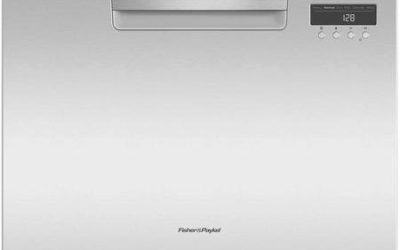
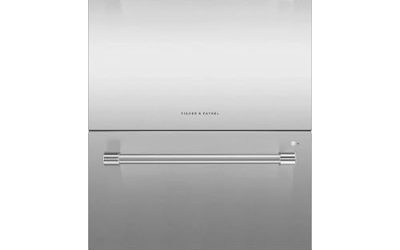
Fisher & Paykel DD24DAX9 N Double DishDrawer (Series 7)
| Spec | Detail |
|---|---|
| Configuration | Two independent drawers, built-in |
| Place settings | 14 total, 7 per drawer |
| Dimensions (H x W x D) | 32 5/16 to 34 5/8 in x 23 9/16 in x 22 9/16 in |
| Wash programs | 6 (Delicate, Eco, Fast, Heavy, Medium, Rinse) |
| Noise | 43 dBA on the standard cycle, top drawer |
| Water use | 3.44 gal per cycle running both tubs |
| Energy use | 265 kWh per year |
| Power | 110 to 120V, 60Hz |
| Drying | Fan assisted |
| Included accessories | Cutlery basket, kickstrip |
| Finish | Stainless steel, Contemporary |
Why it fits the two-load routine. The DD24DAX9 N is the standard-height double DishDrawer, and it covers the core promise of the format without extras you may never touch: two fully independent drawers, six programs each, and a true half load in either drawer. In daily use that means the top drawer can be your always-available drawer — it takes the day’s glasses, plates and cutlery and runs a Fast or Eco program whenever it fills — while the bottom drawer collects cookware and oven dishes for a Heavy program in the evening. The maker also designs this model for ergonomic accessibility, with both drawers at bench height, so loading the lower drawer involves far less bending than loading the bottom rack of a drop-door machine. Fan-assisted drying helps both drawers finish with drier dishes than air-dry-only designs.
Trade-offs. There are no wash modifiers on this model: no sanitize option for the final rinse and no extra-dry setting aimed at plastics, so if those matter, look at the Series 9 pick below. The standard-height drawers also cap the size of plates and platters you can stand upright, particularly in the top drawer. And like every model in this guide, capacity is split: a single drawer holds seven place settings, so one very large item can crowd a drawer quickly.
Best for / Skip if. Best for households that want the two-independent-loads workflow in a standard-height opening and are happy with a clean, simple program set. Skip it if your dinner plates are oversized, if you regularly want a sanitize rinse, or if your opening is tall enough that you would rather use the extra space for capacity.
Fisher & Paykel DD24DV2T9 N Double DishDrawer (Series 9)

| Spec | Detail |
|---|---|
| Configuration | Two independent tall drawers, built-in |
| Place settings | 14 total, 7 per drawer |
| Dimensions (H x W x D) | 34 to 36 3/8 in x 23 9/16 in x 22 9/16 in |
| Plate clearance | Round plates up to 12.25 in in the top drawer, 11 in in the bottom drawer |
| Wash programs | 6 (Delicate, Eco, Fast, Heavy, Medium, Rinse) |
| Wash modifiers | Quick, Sanitize, Extra Dry |
| Noise | 42 dBA on the standard cycle, top drawer |
| Water use | 3.28 gal per cycle running both tubs |
| Energy use | 263 kWh per year |
| Power | 120V, 60Hz |
| Controls | Internal wash selector, Wi-Fi connectivity, child lock, delay start |
| Included accessories | Cutlery basket, knife clip, multipurpose clip, kickstrip |
| Finish | Stainless steel, Professional |
Why it fits the two-load routine. The DD24DV2T9 N is the tall version of the double DishDrawer, and the extra height is concentrated where it helps most: the top drawer takes round plates up to 12.25 inches across, so the drawer you use most often is also the one that swallows large dinner plates and taller items without awkward angling. The three wash modifiers widen the gap between what the two drawers can do at the same time. One drawer can run Delicate with no modifier for crystal while the other runs Heavy with Sanitize — the maker specifies that the Sanitize option kills 99.9 percent of bacteria in the final rinse — for chopping boards and cookware. Extra Dry addresses the format’s usual weakness with plastic containers, and Quick shortens a lightly soiled drawer load when you need the dishes back in service. Wi-Fi connectivity and a delay start option also make it easier to stagger the two drawers around your day rather than starting both at once.
Trade-offs. The tall body is the main constraint: at 34 to 36 3/8 inches installed height, it needs a taller opening than the standard model, and it will not fit a space built for the shorter machine. The internal controls and longer option list take a little more learning than the simpler Series 7 interface. Per-drawer capacity is still seven place settings, so the tall drawers solve a height problem, not a volume problem.
Best for / Skip if. Best for households with a tall opening, large plates, and mixed loads that benefit from sanitize or extra-dry modifiers running in one drawer while the other does something gentler. Skip it if your opening is standard height, or if you know you will only ever run the same everyday program in both drawers — the simpler model covers that for less complexity.
How to choose between these picks
Start with your tape measure. If the opening under your counter is in the standard range, the DD24DAX9 N is the one that fits, and the decision is made. If you have the taller opening the Series 9 needs, the choice becomes about dishes and habits. Measure your largest dinner plates: if they are above roughly 11 inches and you wash them daily, the tall top drawer of the DD24DV2T9 N removes a daily annoyance. Next, think about what your second load usually is. If it is typically more of the same everyday dishes, the Series 7 program set is enough. If your second load is often the awkward one — boards and knives after raw meat, plastics that never dry, glassware you do not trust to a hot program — the modifiers on the Series 9 earn their place. Finally, consider who loads the machine: the Series 7’s simpler controls suit households where several people, including guests or older family members, need to start a drawer without instruction.
Running two drawers day to day: setup, workflow and care
Setup. A two-drawer machine installs into the same 24-inch-wide space as a conventional dishwasher, with one water inlet, one drain connection and one power supply serving the whole unit; the adjustable height range is how each model meets your countertop. Level the machine carefully during installation, because two independent drawers sliding on their runners are less forgiving of a tilted cabinet than a single door. Before the first wash, add rinse aid to each drawer’s dispenser and run each drawer empty once on a rinse or fast program to clear the system.
Workflow. The routine that makes this format work is to give the drawers roles. Many households use the top drawer as the daily drawer — it fills through the day and runs in the evening — and keep the bottom drawer for cookware, serving dishes and the overflow from entertaining. Because a drawer can stay closed with clean dishes inside, the second drawer doubles as storage: unload the drawer you need, leave the other closed, and keep loading dirty items into the free one. When both drawers fill on the same day, stagger the starts by half an hour if noise bothers you, or start both together if it does not. Use powdered detergent as the maker directs for drawer machines, and dose per drawer rather than doubling up.
Care. Each drawer has its own filter and spray arm, so clean both sets, not just the drawer you use most; a neglected second drawer is the usual source of odours in these machines. Wipe the drawer seals weekly, since the top edge of each drawer collects splashes. Check and top up rinse aid in both dispensers, and run an occasional empty hot wash in a drawer that mostly sees light loads. If a drawer shows a fault code, the manual’s diagnostic list is the first stop — the drawers report faults independently, which also tells you which half of the machine needs attention.
FAQ
Can both drawers really run at the same time, on different programs?
Yes. That is the defining feature of both picks. Each drawer has its own wash system and program selection, so one drawer can run Heavy while the other runs Delicate, and each can be started, opened and unloaded on its own schedule.
Is the capacity the same as a standard dishwasher?
On paper, yes: both models hold 14 place settings in total. In practice the capacity is split into two seven-place-setting drawers, which is more flexible for small loads but less forgiving of a single oversized item, since nothing can span both drawers. The tall Series 9 model eases this with its 12.25-inch top-drawer plate clearance.
What size opening do I need?
Both models are built for a 24-inch-wide opening with a depth of 22 9/16 inches. The difference is height: the DD24DAX9 N adjusts from 32 5/16 to 34 5/8 inches, while the tall DD24DV2T9 N needs 34 to 36 3/8 inches. Measure your opening height first, as it can settle the choice on its own.
Can I run just one drawer and leave the other empty?
Yes, and that is the everyday pattern for most owners. Each drawer holds a true half load and washes independently, so a small load in one drawer uses only that drawer’s share of water and energy rather than running a full-size tub for a few plates.
Do the two drawers need separate plumbing?
No. The unit connects to a single water supply and drain like a conventional built-in dishwasher; the two drawers share the machine’s connections while keeping separate wash systems. Follow the installation guide for your exact model, and confirm your supply and drain positions before ordering.
Conclusion
If your opening is standard height and your goal is simply to end the standoff between a running dishwasher and a pile of dirty dishes, the Fisher & Paykel DD24DAX9 N is the recommendation: two independent drawers, six programs each, and nothing superfluous. If you have the taller opening, larger plates, or a regular need for a sanitize rinse or help drying plastics in one drawer while the other runs a gentle load, the Fisher & Paykel DD24DV2T9 N is the better fit and the more capable two-load machine. Either way, measure the opening height and your largest plates before you order, and check the current listing for the exact configuration — in a category this narrow, fit matters more than features.