Key takeaways
- Find the best window fans for smoking and clear stale air fast. Compare reversible twin fans for smoke ventilation, exhaust power, window fit, and quiet use.
Best Window Fans for Smoking
When smoke hangs in a room, opening a window is rarely enough on its own. The best window fans for smoking are the ones that actively push smoky air outside instead of just stirring it around, and the difference comes down to exhaust power, reversible airflow, and a seal that keeps smoke from drifting back in. A good window fan turns an open window into a real ventilation system, pulling stale air out and drawing fresher air in from another opening in the home.


The quick answer is to choose a reversible twin window fan with an exhaust mode, a strong motor, and expandable side panels that close the gaps around the unit. Twin fans matter because they move more air than a single fan, and reversible blades let you switch between pulling fresh air in and pushing smoky air out without removing the fan from the window. If you want a set-and-forget option, look for a model with a thermostat and a remote so you can run the fan on exhaust until the room clears, then switch to intake for fresh air.
Smoke ventilation is a different job from cooling a bedroom on a warm night. A fan used for smoke needs to move a large volume of air quickly, hold up to long run times, and keep running steadily while the room clears. This guide compares five twin window fans that fit that job, explains what to look for, and helps you match a model to your window size and your room.
Quick Picks
Our Short List of 3
All 5 Picks at a Glance
| Product | Specs | Action |
|---|---|---|
| Bionaire Window Fan with Reversible Airflow Blades (B000065DKJ) | Check price on Amazon | |
| Comfort Zone Twin Window Fan CZ319WT (B0118ECP7M) | Check price on Amazon | |
 Comfort Zone Window Fan with Remote CZ310R (B004TAYQXE) | Check price on Amazon | |
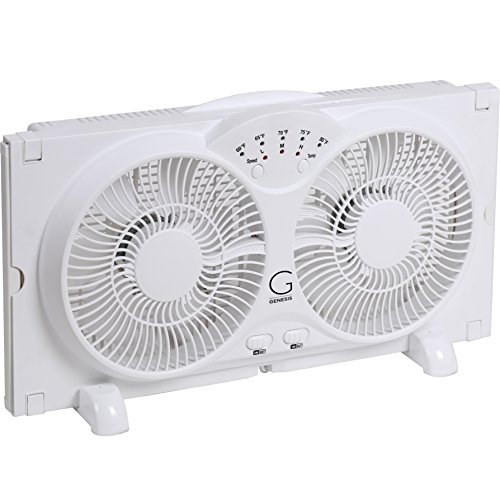 Genesis Twin Window Fan A1WINDOWFAN (B01CK64AQG) | Check price on Amazon | |
 Amazon Basics Twin Window Fan (B07YJCTXN5) | Check price on Amazon |
How to Choose
Exhaust Power and Airflow
The single most important factor for clearing smoke is how much air the fan can move out of the room. Look for twin-fan designs with two motors or two independently controlled blades, since they push more air than a single fan of the same size. Listed airflow figures vary between brands, so compare models on blade size, motor type, and the number of speed settings as well. A fan with a high speed setting gives you a strong exhaust burst for clearing a room quickly, while lower speeds work for keeping air moving afterward.
Reversible Airflow
A reversible fan is essential for smoke ventilation. In exhaust mode, both blades push indoor air outside, which is what clears smoke. In intake mode, the fan draws outdoor air in, which helps once the smoke is gone and you want fresh air circulating. The most useful models add a third exchange or circulate mode, where one blade pulls air in while the other pushes air out, giving you balanced ventilation through a single window. Electronic reversal, controlled by a button or remote, is far more convenient than models that require you to lift the whole unit out of the window and turn it around.
Window Fit and Sealing
A window fan only works well if the air has nowhere to go except through the fan. Expandable side panels that lock into place close the gaps on either side of the unit, so smoky air is forced out through the blades instead of leaking back around the edges. Measure your window width before buying and check the fan’s fit range against it. Most twin window fans fit windows between roughly 22 and 37 inches wide, but the exact range varies by model.
Speed Settings and Controls
Three speed settings give you more control than two. High speed clears a smoky room faster, medium speed keeps air moving comfortably, and low speed works for background ventilation. A remote control is genuinely useful here, because you can switch the fan to exhaust or change the speed without walking over to the window. Some models add a programmable thermostat that turns the fan on and off automatically based on room temperature.
Noise Level
Exhaust fans move a lot of air, and moving air makes sound. That trade-off is hard to avoid, but some models are noticeably quieter than others at the same airflow level. If the fan will run in a bedroom or a living room while people are talking or watching television, check the listed noise level and look for a model with a low speed that stays quiet. Running the fan on high for a short clearing burst and then dropping to a lower speed is a practical way to balance fast ventilation with a comfortable noise level.
Safety and Build Quality
A window fan used for smoke ventilation may run for hours at a time, so build quality matters. Look for ETL certification, which shows the fan meets recognized safety and performance standards. A sturdy housing, a protective bug screen, and a removable fabric cover all help the fan last longer and stay clean. Tabletop feet are a useful bonus, since they let you use the same fan as a freestanding unit on a table or floor when it is not mounted in the window.
The Best Window Fans for Smoking Reviewed
Bionaire Window Fan with Reversible Airflow Blades (B000065DKJ)
The Bionaire is the strongest all-around pick for smoke ventilation because it combines electronic reversible airflow with a programmable thermostat and a remote control. Its twin 8.5-inch blades can be set independently, so you can draw fresh air in, exhaust smoky air out, or run both at once in exchange mode. Three speed settings let you choose between a strong clearing burst and a gentler steady airflow, and the thermostat automatically turns the fan on and off to hold a chosen room temperature. The LED display shows the current setting at a glance, and the remote means you can switch to exhaust mode from across the room the moment smoke appears.
It fits double-hung, vertical slider, and casement windows from 24 to 36 inches wide, with a built-in accordion extender panel and an additional extender panel for a secure fit. The unit is ready to use with no assembly required, and it carries a 3-year limited warranty. At 6.6 pounds it is light enough to lift into place with one hand, and the listed noise level is 30 dB, which is quiet for a fan in this class.
This fan suits anyone who wants the most capable smoke ventilation setup in a single unit, especially in a living room or bedroom where the fan will run often. Skip it if you need the widest possible window fit, since some competing models stretch a little further, or if you prefer the simplest possible manual controls with no digital display.
Comfort Zone Twin Window Fan CZ319WT (B0118ECP7M)
The Comfort Zone CZ319WT is a straightforward budget pick that does the core job well: two 9-inch fans that move air in or out of the room. It has two speed settings, low and high, controlled by a simple manual dial, and the reversible function lets you switch between drawing fresh air in and pushing stale air out. Auto-locking accordion expanders adjust to fit window openings from 22.25 to 33 inches wide and lock in place for a secure seal. A removable fabric cover and bug screen keep insects and debris out when the fan is running or idle.
One of its most practical features is the pair of sturdy feet, which lets you set the fan on a tabletop or floor as a freestanding unit. A carrying handle makes it easy to move from room to room, so you can place it in whichever window is closest to the source of the smoke.
This fan suits anyone who wants an affordable, no-fuss exhaust fan for a smaller room, a kitchen, or a home office. It also suits renters and anyone who moves the fan between rooms, thanks to the handle and the tabletop feet. Skip it if you want a remote control, a thermostat, or more than two speed settings, since this model keeps things deliberately basic.
Comfort Zone Window Fan with Remote CZ310R (B004TAYQXE)
The Comfort Zone CZ310R adds remote control and a third airflow mode to the brand’s twin-fan design, making it one of the most flexible options for smoke ventilation. It offers three modes: Cool, which brings fresh air in with both fans; Circulate, which pulls fresh air in with one fan while the other exhausts stale air; and Exhaust, which uses both fans to push indoor air out. That Exhaust mode is the one to use when smoke needs clearing, while Circulate mode is ideal for keeping air moving afterward. Three speed settings give you low, medium, and high airflow, and the included remote lets you change speed, mode, and power from across the room.
The accordion expanders adjust from 23.5 to 37 inches wide, which covers a broader range of windows than most budget twin fans, and they lock in place once set. A fabric cover and bug screen are included, and the unit runs on 70 watts at 120 volts.
This fan suits anyone who wants to control smoke ventilation without getting up, including people who run the fan in a bedroom at night or in a large living room. It also suits wider windows, since its fit range reaches 37 inches. Skip it if you want a thermostat for automatic temperature-based operation, since this model does not include one.
Genesis Twin Window Fan A1WINDOWFAN (B01CK64AQG)
The Genesis twin window fan is built for raw airflow, with two 9-inch fan heads driven by their own copper motors and a high-velocity design aimed at moving large volumes of air. It offers three speed settings, low, medium, and high, and a built-in thermostat with a range from 60 to 80 degrees, with LED indicator lights that show the temperature setting. The reversible airflow design lets both fans work together for intake or exhaust, so you can push smoky air out of a room quickly and then switch to drawing fresh air back in.
Expandable side panels add 6.5 inches on either side, giving the fan a flexible fit across many window sizes, and the unit measures 24 by 12 by 4 inches. The copper motors are built to endure long run times, which matters for a fan that may run for hours while a room clears.
This fan suits anyone who prioritizes maximum airflow above all else, especially in larger rooms where a smaller fan would struggle to clear smoke. Skip it if you need a lightweight, portable fan, since this model is bulkier than the slimmer options here, or if you want a remote control, which this model does not include.
Amazon Basics Twin Window Fan (B07YJCTXN5)
The Amazon Basics twin window fan is the simplest pick in this roundup, and for many rooms it is all you need. It has two 9-inch fans with two speed settings and reversible airflow, so you can set it to pull fresh air in or flip it in the window to use it as an exhaust fan. The expandable side panels fit standard windows from 25 to 32 inches wide, and the copper motor is designed for consistent, reliable operation. Manual controls keep operation simple: pick a speed, pick a direction, and the fan does its job.
At 5.7 pounds it is one of the lightest fans here, which makes it easy to lift into a window and remove again. The compact design suits small to medium spaces, and the straightforward controls mean there is nothing to program or configure.
This fan suits anyone who wants the lowest-fuss option for a small or medium room, and anyone buying a first window fan who does not want to pay for features they will not use. Skip it if your window is wider than 32 inches, since the panels do not stretch as far as competing models, or if you need three speeds, a remote, or a thermostat. It also suits smaller rooms better than large open spaces, where a higher-airflow model will clear smoke faster.
What to Check Before You Buy
Measure your window before you order anything. A fan that does not fit leaves gaps, and gaps let smoky air leak back into the room instead of being pushed outside. Check both the width range and the height of the fan against your window opening, and remember that sliding windows and casement windows have different shapes that may suit different models.
Think about where the replacement air will come from. An exhaust fan works best when there is another opening, such as a window or door elsewhere in the home, that lets fresh air in as the smoky air is pushed out. Without a source of incoming air, the fan has to work harder and clears the room more slowly. Cracking a window in another room while the fan runs on exhaust gives the air a clear path through the home.
Decide how much control you want. If you will switch between exhaust and intake often, electronic reversal and a remote are worth having. If the fan will mostly sit in one window on one setting, a simple manual model saves money and still clears smoke effectively. A thermostat is worth considering if you want the fan to keep ventilating on its own while you are busy elsewhere.
Check the fan’s power draw and cord length. Most twin window fans plug into a standard outlet and draw modest power, but the outlet needs to be within reach of the cord. Also check whether the fan can be used as a tabletop unit, since that flexibility is useful when you want ventilation in a room without a suitable window.
Finally, plan for cleaning. Smoke and dust build up on fan blades and screens over time, and a fan with a removable cover and an accessible blade area is much easier to keep clean. A quick wipe of the blades and a rinse of the bug screen every few weeks keeps airflow strong and keeps the fan running quietly.
FAQ
Can a window fan really clear smoke from a room?
Yes, when it is set to exhaust mode. A window fan in exhaust mode actively pushes indoor air outside, which removes smoke far faster than an open window alone. For the best result, open a window or door in another room so fresh air can flow in to replace the air being pushed out.
Should I use intake or exhaust mode for smoke?
Use exhaust mode to clear smoke. Exhaust mode pushes smoky air out of the room, while intake mode draws outdoor air in. Once the smoke is gone, switch to intake or circulate mode to bring in fresh air and keep the room ventilated.
Do I need a twin fan, or is a single fan enough?
A twin fan moves more air than a single fan of the same size, so it clears smoke faster. Twin fans also offer exchange modes where one blade pulls air in while the other pushes air out. A single fan can still help, but for smoke ventilation a twin design is the stronger choice.
What window size do these fans fit?
Most twin window fans in this guide fit windows between about 22 and 37 inches wide, depending on the model. Always measure your window and compare it with the fan’s listed fit range before buying, since a fan that is too narrow or too wide will leave gaps.
How long should I run the fan after the smoke is gone?
Keep the fan running on exhaust for a while after the visible smoke has cleared, since stale air can linger even when you can no longer see it. Switching to circulate or intake mode afterward brings fresh air in and helps the room feel ventilated again.
Bottom Line
The best window fans for smoking are reversible twin fans that push smoky air out fast and seal tightly into the window. The Bionaire BW2300 is the top pick for its thermostat, remote, and independent blade control, while the Comfort Zone CZ310R is the best remote-controlled option for wider windows. The Genesis twin fan delivers the strongest airflow for larger rooms, the Comfort Zone CZ319WT is the best budget choice for smaller spaces, and the Amazon Basics twin fan is the simplest value pick. Whichever model you choose, measure your window first, run the fan on exhaust to clear smoke, and give fresh air a second opening to flow in through.
Disclosure: As an Amazon Associate, we may earn from qualifying purchases.