Key takeaways
- Compare the best dish drawer dishwashers for waist-height loading: single and double DishDrawer models checked on capacity, plate clearance, noise and fit.
A dish drawer dishwasher replaces the drop-down door of a conventional machine with one or two drawers that pull out toward you, the same way a kitchen cabinet drawer does. That single design change is the whole point of the format: the tub sits at bench height, so you load and unload standing upright instead of bending down to a low rack, and each drawer washes as an independent machine. This guide is for anyone who finds a standard dishwasher awkward to load — because of a bad back, limited mobility, a seated workflow, or simply a kitchen routine built around small, frequent loads — and wants to know which drawer models are actually sold on Amazon US.

The honest starting point is that the drawer category on Amazon US is narrow. Fisher & Paykel created the DishDrawer format and remains effectively the only maker with verifiable drawer dishwasher listings there, so every pick below is a Fisher & Paykel model. The choice is therefore not about brand; it is about configuration — one drawer or two, standard height or tall — and about how the drawer format fits your body, your cabinetry and your dish volume. Picks are based on manufacturer specifications and Amazon listing details, not on any in-person testing.
Disclosure: As an Amazon Associate, we earn from qualifying purchases. Product details and availability can change; check the Amazon listing before you buy.
Quick picks at a glance
| Product | ASIN | Best for |
|---|---|---|
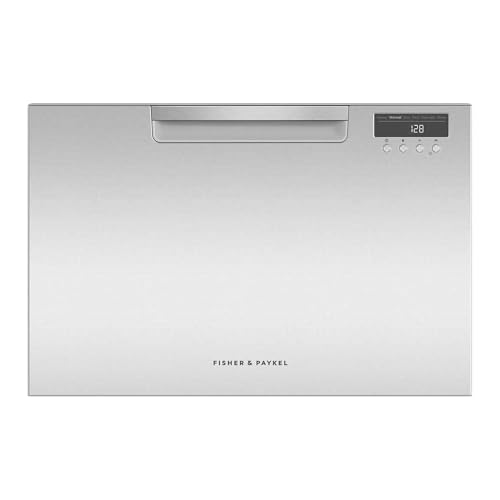
| Fisher & Paykel DD24SAX9 N Single DishDrawer | B07GZ22W6Y | One drawer at waist height in a half-height opening |
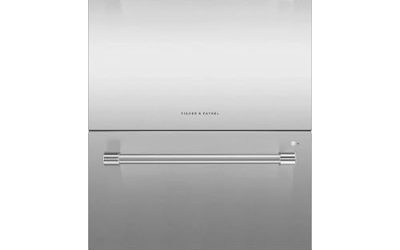
| Fisher & Paykel DD24DAX9 N Double DishDrawer | B07DM73CX5 | Two independent drawers in a standard opening |
| Fisher & Paykel DD24DV2T9 Double DishDrawer | B07GSDDXJV | Tall drawers for large plates, plus Wi-Fi control |
What matters most when you buy for the drawer format
Loading height and reach. The ergonomic case for a drawer machine rests on geometry. A single drawer installs in a half-height opening, so its rim sits roughly at counter height and every item is placed from above at waist level. In a double drawer, the top drawer keeps that advantage; the bottom drawer sits lower, though still higher than the bottom rack of a drop-door machine. If avoiding bending is the main reason for buying, weigh how often you would use the lower drawer.
Drawer independence. Each DishDrawer tub has its own wash system and controls, so two drawers can run different programs at the same time, or one can run while the other is still being filled. That independence is what makes small loads practical: a drawer holding a true half load uses water and energy sized to that load rather than to a full-size tub.
Plate and cookware clearance. Drawer tubs are shallower than a full-height dishwasher interior. Standard drawers in this guide fit plates up to about 11 inches across; tall drawers raise that clearance to about 12.25 inches in the top drawer. Measure your largest plates, platters and stockpots before choosing, because clearance — not place settings — is the limit most owners run into.
Capacity per drawer. Each drawer holds about 7 place settings, so a double drawer matches a conventional machine at 14 settings in total but splits them into two separately washed batches. Households that run one large mixed load after every meal may prefer a single big tub; households that wash as they go get more from the split.
Installation footprint. A single drawer needs an opening about 16 inches high; a double needs roughly 32 to 36 inches depending on the model, within the standard 24-inch width. Adjustable-height models give the installer some tolerance. All three picks are built-in units that hardwire or plug into a standard 120-volt supply and connect to a normal hot-water feed and drain.
Noise. Drawer machines run at listed figures between 42 and 45 dBA in this guide, comparable to quiet conventional models. Because the drawers sit higher in the cabinet run, sound carries a little differently than from a floor-level tub, but the published figures are the right basis for comparison.
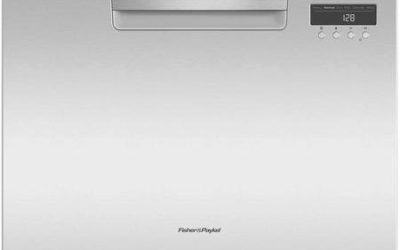
Fisher & Paykel DD24SAX9 N Single DishDrawer
| Spec | Detail |
|---|---|
| Configuration | Single drawer, built-in |
| Capacity | 7 place settings |
| Wash programs | 6 |
| Noise level | 45 dBA |
| Dimensions (W × D × H) | 23 9/16 × 22 9/16 × 16 1/8 in |
| Finish | Ezkleen stainless steel |
| Supply | 120 volts |
Why it fits the drawer format. This is the purest version of the idea: one drawer, installed in a half-height opening, that you load entirely from above at bench height. There is no lower tub to bend to at all, which makes it the strongest pick in this guide for anyone whose main goal is avoiding stooping. The freed cabinet space below or above the opening can stay as storage, something no full-height machine allows. Six wash programs cover the normal range from delicate glassware to a heavy cookware cycle.
Trade-offs. Seven place settings is a hard ceiling — a large family’s dinner service will not fit in one cycle, and oversized platters are limited by the standard drawer clearance. At 45 dBA it is the loudest of the three picks, though still in the quiet range for the category. One drawer also means one load at a time, with no second tub to stage the next batch.
Best for / Skip if. Best for one- and two-person households, accessible kitchens, and anyone adding a second dishwasher point in a bar or butler’s pantry. Skip it if you regularly wash for four or more people in a single load.
Fisher & Paykel DD24DAX9 N Double DishDrawer
| Spec | Detail |
|---|---|
| Configuration | Double drawer, built-in |
| Capacity | 14 place settings (7 per drawer) |
| Wash programs | 6 |
| Noise level | 43 dBA |
| Dimensions (W × D × H) | 23 9/16 × 22 9/16 × 32 5/16 to 34 5/8 in (adjustable height) |
| Energy use | 265 kWh per year |
| Water use | 3.44 gallons per cycle, both tubs |
| Drying | Fan assisted |
| Compliance | ADA compliant, Energy Star certified |
Why it fits the drawer format. The double drawer keeps the waist-height loading of the single for its top tub and adds a second independent drawer beneath it, filling a standard dishwasher opening. The two tubs run entirely separate programs, so glasses can wash gently above while a roasting pan gets a heavy cycle below. Because each drawer accepts a true half load, the machine suits households that would otherwise run a big tub half empty. Adjustable installed height helps it sit flush in an existing cutout.
Trade-offs. The lower drawer reintroduces some bending, even if less than a drop-door rack. Plate clearance is about 11 inches in both drawers, so tall stemware and large serving platters need checking. Fan assisted drying works well on ceramics and glass but leaves plastics wetter than a heated dry would.
Best for / Skip if. Best for families who wash in batches through the day and for entertainers who want a second load running while the first finishes. Skip it if your largest plates exceed the drawer clearance or if you want app control.
Fisher & Paykel DD24DV2T9 Double DishDrawer
| Spec | Detail |
|---|---|
| Configuration | Double drawer, tall, built-in |
| Capacity | 14 place settings (7 per drawer) |
| Wash programs | 6, plus Quick Wash, Sanitize and Extra Dry modifiers |
| Noise level | 42 dBA |
| Dimensions (W × D × H) | 23 9/16 × 22 9/16 × 34 to 36 3/8 in (adjustable height) |
| Energy use | 263 kWh per year |
| Water use | 3.28 gallons per cycle, both tubs |
| Connectivity | Wi-Fi enabled |
| Top drawer clearance | Fits plates up to 12.25 in |
Why it fits the drawer format. The tall double drawer answers the format’s main weakness — headroom. Its top drawer accepts plates up to 12.25 inches across, so full-size dinner plates and larger cookware load the way they would in a conventional machine, while still pulling out at bench height. It is also the quietest pick here at a listed 42 dBA, and the only one with Wi-Fi, so a cycle can be started or checked from a phone instead of at the control panel. The Sanitize and Extra Dry modifiers extend the six base programs for baby bottles, jars and plastic containers.
Trade-offs. The taller body needs the most opening height of the three, so confirm the cutout before ordering; it will not fit every existing space. The bottom drawer still sits low, and the Wi-Fi features only matter if your household will actually use remote control. As the flagship of the range it is the most complex option here, with more settings to learn.
Best for / Skip if. Best for households with large plates or tall cookware, open-plan kitchens where noise carries, and anyone who wants remote control. Skip it if your opening is height-limited or you prefer the simplest possible control set.
How to choose between these picks
Start with your opening. If you have a half-height space — or want to create one and keep storage beside it — the single DD24SAX9 N is the only configuration that fits, and it also gives the most completely bend-free loading. If you have a standard full-height opening, the decision moves to clearance and features: choose the DD24DAX9 N when your plates are 11 inches or under and you want the straightforward double-drawer setup, and choose the DD24DV2T9 when plates run larger, when the kitchen opens into living space and the lower noise figure matters, or when Wi-Fi control is worth having.
Then sanity-check your routine. Drawer machines reward washing in smaller, more frequent batches. If your household produces one large mixed load a day, two 7-setting drawers handle it as two cycles rather than one; that is a workflow change, not a defect, but it should be a deliberate choice. Finally, measure your three largest items — biggest plate, tallest glass, deepest pot — and compare them against the drawer clearance figures above before committing.
Installing and living with a dish drawer
A drawer dishwasher installs into a standard 24-inch-wide cabinet opening with a hot-water feed, a drain connection and a 120-volt supply, much like a conventional built-in. The differences are in the details: the unit must be levelled and secured so the drawers slide true, and the adjustable-height models should be set so the top drawer front aligns with the surrounding cabinet fronts. Leave the clearances the maker specifies around the drawers so the seals seat properly when they close.
Day to day, loading a drawer differs from loading a rack. Items are placed from above, so arrange plates facing the centre and keep tall items toward the back of the tub where clearance is greatest. Because each drawer seals with a lid that closes automatically when the drawer is pushed in, nothing should sit proud of the tub rim. Use the detergent format the maker specifies for the dispenser, keep the filter at the base of each tub rinsed clear — it lifts out from above, another small ergonomic win — and wipe the drawer seals periodically so they keep their watertight fit. Run the lower drawer of a double at least occasionally even if you favour the top one, so its seals and hoses stay exercised.
FAQ
Is a dish drawer easier to load than a normal dishwasher?
For most people, yes. The tub pulls out to bench height and is loaded from above, so there is no crouching to reach a bottom rack. In a double drawer the lower tub still requires some bending, though less than a drop-door machine.
Can the two drawers of a double DishDrawer run at the same time?
Yes. Each drawer has its own wash system and controls, so they can run different programs simultaneously, run one at a time, or one can be loaded while the other washes.
What size plates fit in a dish drawer?
Standard drawers fit plates up to about 11 inches across. The tall top drawer of the DD24DV2T9 raises that to about 12.25 inches. Check your largest plates against these figures before buying.
Does a single drawer use less water than a full-size dishwasher?
A single drawer washes a true half load, and the double models list water use of about 3.3 to 3.5 gallons per cycle with both tubs running. Running one drawer for a small load uses proportionally less than filling a full-size tub for the same dishes.
Who else makes drawer dishwashers besides Fisher & Paykel?
On Amazon US, effectively no one else at the time of writing. Fisher & Paykel originated the format, and its DishDrawer models are the drawer dishwashers with verifiable Amazon US listings; other brands sell drop-door machines in drawer-adjacent styles but not true pull-out drawer tubs.
Conclusion
If the drawer format itself is the attraction — loading at waist height, washing in small independent batches, no bending to a low rack — the choice comes down to configuration. Pick the single DD24SAX9 N for a half-height opening and the most completely bend-free loading. Pick the DD24DAX9 N for a standard opening and two independent drawers with a simple, proven control set. Pick the tall DD24DV2T9 if your plates are large, your kitchen is open-plan, or you want the quietest operation and Wi-Fi control. Whichever you choose, measure your opening and your largest plates first; in this category, fit is the decision.