Our Short List of 3

- Best for: A first home station where one radio should do everything well.
- 100W output on HF and 50 MHz
- Direct-sampling SDR receiver with real-time spectrum scope and waterfall
- 4.3-inch color TFT touchscreen display
- Built-in automatic antenna tuner

- Best for: Portable operating where a built-in tuner and 20 watts matter most.
- 20W output on HF, SSB/CW/AM/FM modes
- SDR architecture with built-in automatic antenna tuner
- 1.8-inch color TFT LCD with 48 kHz spectrum display and waterfall
- Detachable display unit with remote head cable
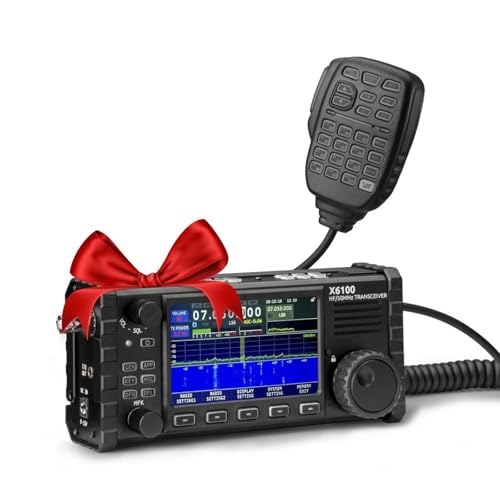
- Best for: A pocket field station that needs no extra battery, tuner, or screen.
- 10W output on external power, 5W on internal battery
- HF/50MHz full mode with data communication support
- Built-in 3000mAh rechargeable lithium battery
- Built-in automatic antenna tuner, VSWR up to 1:5.0
All 3 Picks at a Glance
| Product | Specs | Action |
|---|---|---|
| Icom IC-7300 |
| Check price on Amazon |
| Xiegu G90 |
| Check price on Amazon |
| Xiegu X6100 |
| Check price on Amazon |
Key takeaways
- Compare the best HF ham radios for home, mobile and portable use, from 100-watt base stations to pocket QRP rigs, with real specs and buying guidance.
Choosing an HF ham radio is really a choice about how you plan to operate. A 100-watt base station makes contacts easy from a fixed shack, but it needs a power supply, a real antenna system, and a desk that never moves. A pocket QRP rig slips into a backpack and runs all day from a small battery, yet five watts demand good antennas, good propagation, and patience when the bands are crowded. Most buyers land somewhere in between, and the wrong pick usually shows up as a radio that never leaves the shelf.
This article covers five radios chosen from names and specifications on Amazon product pages, spanning a full-power home station, a compact mobile rig, and three portable SDR radios. It suits new General licensees building a first station, portable operators who hike to summits and parks, and experienced hams adding a second radio for travel. Every pick below is a complete transceiver sold on Amazon US, with its power, bands, and tuner situation stated plainly.
Quick Picks
As an Amazon Associate we earn from qualifying purchases
| Product | Best for | Key spec from title |
|---|---|---|
| Icom IC-7300 | First home station | 100W HF/50MHz direct-sampling SDR |
| Yaesu FT-891 | Mobile and small-desk 100W | 100W HF/50MHz all-mode mobile |
| Xiegu G90 | Portable operating with a tuner | 20W HF SDR with built-in auto tuner |
| Xiegu X6100 | Self-contained field station | 10W HF/50MHz SDR with battery |
| Xiegu G106 | Ultralight backpack QRP | 5W HF SDR QRP transceiver |
How to Choose
Power output and what it buys you
Output power sets how forgiving a radio is. A 100-watt radio pushes through marginal conditions, noisy bands, and pileups that a 5-watt rig cannot crack, which is why most first stations start at full power. Twenty watts covers most portable contacts when the antenna is decent, while five watts is true QRP: rewarding on a good day, frustrating on a bad one. Match power to your patience and your antenna, not to a number on a box. A modest radio with a proper outdoor antenna beats a powerful radio feeding a compromise indoor wire every time.
Receiver design and the waterfall display
Modern HF radios split into direct-sampling SDR designs and conventional superheterodyne designs, and the difference shows in how you find signals. A direct-sampling receiver with a real-time spectrum scope and waterfall shows band activity at a glance, so you can see where stations are instead of tuning blindly. The IC-7300 made this mainstream, and the Xiegu portables follow the same idea. The FT-891 uses a superheterodyne receiver with strong 32-bit DSP instead, which handles strong nearby signals well. Decide whether you want to watch the band or tune by ear.
Antenna tuner, battery, and portability
A built-in automatic tuner changes portable operating completely, because it lets a random wire or end-fed antenna work on several bands without extra hardware. The G90 and X6100 both include one, while the FT-891 and G106 do not, so those two need a resonant antenna or an external tuner. Battery power matters just as much in the field: the X6100 carries its own rechargeable battery, the G90 and G106 run from an external 12-volt source, and the 100-watt radios need a serious supply. Check tuner and power before you check anything else.
Modes, bands, and digital operating
Every radio here covers SSB and CW, but the details separate them. The IC-7300 and FT-891 add FM and RTTY, and the IC-7300 covers 6 meters alongside HF, while the G106 covers HF only with no FM transmit. Digital modes such as FT8 matter to many operators now: the G106 and X6100 support FT8 through a sound-card connection, the IC-7300 handles digital modes through its built-in USB audio interface, and the FT-891 needs its rear data port wired correctly. Confirm the mode and the connection your operating style needs before ordering.
The 5 Best Options
Icom IC-7300
- Best for: A first home station where one radio should do everything well.
- 100W output on HF and 50 MHz
- Direct-sampling SDR receiver with real-time spectrum scope and waterfall
- 4.3-inch color TFT touchscreen display
- Built-in automatic antenna tuner
A first home station where one radio should do everything well.
The Amazon listing bundles the radio with programming software, a cable, and a quick reference card, so confirm the bundle contents in cart; a 13.8-volt power supply and an antenna are not included.
The IC-7300 is the radio most first-time home station builders should start with, because it removes almost every obstacle a new HF operator faces. Its direct-sampling SDR receiver feeds a large color touchscreen with a real-time spectrum scope and waterfall, so finding stations becomes visual instead of guesswork. One hundred watts covers HF and 6 meters, the built-in tuner handles ordinary antennas, and the USB connection carries audio and control to a computer for digital modes. It is a complete desk station in one box.
Watch out for: The Amazon listing bundles the radio with programming software, a cable, and a quick reference card, so confirm the bundle contents in cart; a 13.8-volt power supply and an antenna are not included.
Yaesu FT-891
The FT-891 packs full 100-watt HF power into a radio barely larger than a thick book, which makes it the natural pick for a vehicle, a small desk, or a portable kit built around a battery. Its superheterodyne receiver uses 32-bit floating-point DSP to pull weak signals out of noise, and the large display stays readable in bright conditions. It covers 160 through 6 meters in all modes, stores 99 memories, and works with the ATAS-120A self-tuning antenna system. The three-year Yaesu warranty adds confidence for a radio that will travel.
Specs
- 100W output on HF and 50 MHz
- Superheterodyne receiver with 32-bit floating-point DSP
- Modes: SSB, CW, AM, FM
- 99 memory channels
- Frequency range: 160 to 6 meters
- Compatible with Yaesu ATAS-120A automatic tune antenna
- Dimensions: 8.27 x 6.1 x 2.05 inches
- 3-year manufacturer warranty
Best for: Mobile operating and small desks where a full-power radio must stay compact.
Watch out for: There is no built-in antenna tuner, so budget for a resonant antenna or an external tuner; the fan gets loud during long high-power transmissions.
Xiegu G90
- Best for: Portable operating where a built-in tuner and 20 watts matter most.
- 20W output on HF, SSB/CW/AM/FM modes
- SDR architecture with built-in automatic antenna tuner
- 1.8-inch color TFT LCD with 48 kHz spectrum display and waterfall
- Detachable display unit with remote head cable
Portable operating where a built-in tuner and 20 watts matter most.
No battery is included, so plan for a 12-volt battery or supply; the menu-driven interface takes time to learn, and early production units had inconsistent build quality.
The G90 is the portable operator’s workhorse, because it pairs 20 watts with a wide-range automatic tuner that loads almost any field antenna without extra hardware. Its SDR architecture drives a 1.8-inch color display with a 48 kHz spectrum view and waterfall, the CW filter narrows to 50 Hz, and the detachable front panel lets you place the display where it suits your setup. At 3.53 pounds it fits a pack for park and summit operating, and the I/Q output connects a computer or panadapter for digital modes. Firmware updates keep improving the radio over time.
Watch out for: No battery is included, so plan for a 12-volt battery or supply; the menu-driven interface takes time to learn, and early production units had inconsistent build quality.
Xiegu X6100
- Best for: A pocket field station that needs no extra battery, tuner, or screen.
- 10W output on external power, 5W on internal battery
- HF/50MHz full mode with data communication support
- Built-in 3000mAh rechargeable lithium battery
- Built-in automatic antenna tuner, VSWR up to 1:5.0
A pocket field station that needs no extra battery, tuner, or screen.
Battery capacity figures conflict across retailers, with the maker listing 3000mAh and some sellers listing 3500mAh; firmware polish trails the big Japanese brands, so expect menu quirks.
The X6100 is the most self-contained radio in this lineup, because it combines a 10-watt SDR transceiver, a built-in battery, an automatic tuner, and a 4-inch color screen in an 880-gram body. It covers HF and 6 meters in full mode with data communication support, shows a color waterfall on its 800 by 480 display, and connects a mouse and keyboard over Bluetooth for wireless control. External power gives the full 10 watts, while the internal battery drops output to 5 watts. With the optional amplifier cable it can drive the XPA125B amplifier to 100 watts when you are back at a desk.
Watch out for: Battery capacity figures conflict across retailers, with the maker listing 3000mAh and some sellers listing 3500mAh; firmware polish trails the big Japanese brands, so expect menu quirks.
Xiegu G106
The G106 is the simplest radio here by a clear margin, and that simplicity is the point. It covers HF only at up to 5 watts on SSB, CW, and AM, using an SDR design built on 16-bit codec sampling, with WFM broadcast receive thrown in. There is no color display, no waterfall, and no built-in tuner, just a monochrome screen, physical controls, and a short learning curve. At about 720 grams it is the lightest radio in this article, and its low current draw stretches a small battery through a long day of portable operating.
Specs
- 5W output on SSB/CW/AM, 16-bit CODEC SDR
- Receive frequency: 0.55 to 30 MHz, plus 88 to 108 MHz WFM
- Transmit bands: 80, 60, 40, 30, 20, 17, 15, 12, 10 meters
- Supports FT8 digital mode
- Operating voltage: 9 to 15V DC
- Dimensions: 4.7 x 1.6 x 5.3 inches
- Weight: about 1.6 lb (720 g)
- 18-month manufacturer warranty
Best for: Ultralight backpack operating where every gram and every milliamp counts.
Watch out for: No built-in tuner means a resonant antenna or an external matching solution is required, and five watts demands good antennas and good propagation to make contacts.
Which One Fits Your Situation
Building your first home station
Pick the Icom IC-7300. Its 100 watts, built-in tuner, and visual band scope remove the three biggest barriers for a new operator, and the USB audio interface makes digital modes simple. Add a 13.8-volt supply and a basic wire antenna, and the station is on the air the same day.
Operating mobile or from a small desk
Pick the Yaesu FT-891. Full power in a compact body suits a vehicle install or a crowded desk, and the 32-bit DSP keeps weak signals readable. Pair it with a resonant antenna or an external tuner, since the radio has none built in.
Hiking to summits and parks
Pick the Xiegu X6100 for the lightest self-contained kit, or the Xiegu G90 when you want more power and a stronger tuner. The X6100 needs nothing else to operate, while the G90 needs a battery but tunes almost any wire you throw at it, even a random length of wire tossed into a tree.
Traveling light on a tight budget
Pick the Xiegu G106. It costs far less than the others while still covering HF SSB, CW, and AM, and its weight and current draw suit long days on foot. Bring a resonant antenna, since there is no tuner to save a mismatched wire.
Common Mistakes
- Buying a radio before checking license privileges, since transmitting on HF requires the right license class for the bands you plan to use.
- Skipping the antenna budget, because a modest radio with a proper outdoor antenna outperforms a powerful radio feeding a compromise wire.
- Assuming every listing includes a power supply, microphone, or tuner, when many Amazon listings sell the radio body only or bundle extras that change the contents.
- Choosing five watts for a first radio, then discovering that QRP power needs good antennas and good propagation to make routine contacts.
- Forgetting that HF antennas need space and height, so a radio bought for an apartment balcony may never get a fair chance to perform.
Frequently Asked Questions
Do I need a license to use an HF ham radio?
Yes, transmitting on amateur HF bands requires an amateur radio license, and the license class sets which bands and modes you may use. In the United States the Technician, General, and Extra classes grant increasing HF privileges. You may listen without a license, but you must hold the right class before you transmit.
What is the difference between 5 watts and 100 watts?
Five watts is QRP power, suited to portable operating with good antennas and favorable propagation, while 100 watts pushes through noise, pileups, and marginal conditions far more reliably. The gap is roughly 13 dB, which is the difference between being heard and being missed on a crowded band. Most first stations start at 100 watts for that reason.
Do I need an antenna tuner?
A tuner matches a non-resonant antenna to the radio so power transfers instead of reflecting back. Radios with a built-in tuner, such as the G90, X6100, and IC-7300, handle ordinary wire antennas across bands. Radios without one, such as the FT-891 and G106, need a resonant antenna or an external tuner.
Can these radios work digital modes such as FT8?
Yes, all five support digital modes with the right connection. The IC-7300 carries audio and control over a single USB cable, the X6100 and G106 connect through a sound-card interface, and the FT-891 uses its rear data port. Check the cable and software your setup needs before your first digital session.