Our Short List of 3
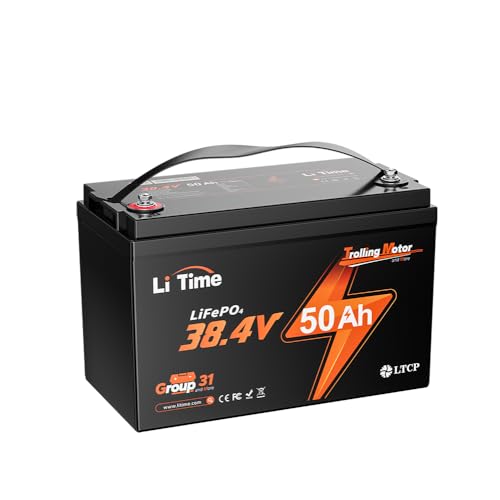
- Group 31 size fits many existing marine battery trays
- Light at 33.14 pounds for a 36 volt pack
- Low-temperature charging and discharging protection
- Parallel expansion up to four batteries

- Bluetooth 5.0 monitoring from a phone
- Group 31 footprint and light 33.1 pound weight
- Low-temperature protection and IP65 housing
- Parallel expansion up to four batteries

- Lightest 50Ah pack here at 32.8 pounds
- Group 31 size for easy tray fitment
- Low-temperature protection and 4,000-plus cycle life
- Simple design with no app to set up
All 3 Picks at a Glance
| Product | Specs | Action |
|---|---|---|
| LiTime 36V 50Ah TM LiFePO4 Battery |
| Check price on Amazon |
| Power Queen 36V 50Ah Bluetooth LiFePO4 Battery |
| Check price on Amazon |
| Redodo 36V 50Ah LiFePO4 Battery |
| Check price on Amazon |
Key takeaways
- Find the best 36 volt deep cycle lithium batteries for trolling motors, boats, and RVs. Compare capacity, BMS, cycle life, and fit before you buy in this guide.
Introduction
The best 36 volt deep cycle lithium batteries replace three heavy 12 volt lead-acid batteries with a single pack that delivers steady power to a 36 volt trolling motor, golf cart, or off-grid setup. For anglers running a 100 to 120 pound thrust trolling motor, that single-battery simplicity matters: there is no series wiring to balance, no watering, and far less weight in the battery compartment. A 36 volt lithium iron phosphate pack, usually called LiFePO4, also holds its voltage flatter through a long day on the water than lead-acid output does.
This guide is for boat owners with a 36 volt trolling motor, golf cart owners converting from lead-acid, and RV or marine users who need a deep-cycle 36 volt source for sustained loads rather than engine starting. Below you will find a quick comparison table, a buying guide, and detailed reviews of four 36 volt deep cycle lithium batteries. Every capacity, dimension, and rating comes from the product listing or the manufacturer specification page, so confirm charger compatibility and fitment for your motor and tray before ordering.
At a Glance
| Product | Best for | Key spec |
|---|---|---|
| LiTime 36V 50Ah TM | Group 31 drop-in replacement for 100-120 lb trolling motors | 50Ah, 1920Wh, 50A BMS, 33.14 lb |
| Power Queen 36V 50Ah Bluetooth | Phone monitoring on a Group 31 trolling motor pack | 50Ah, 1920Wh, Bluetooth 5.0, 50A BMS |
| Redodo 36V 50Ah | Lightweight 50Ah pack without app monitoring | 50Ah, 1920Wh, 50A BMS, 32.8 lb |
| LOSSIGY 36V 100Ah with 25A Charger | Longest runtime with a charger included | 100Ah, 3840Wh, 200A BMS, 66.9 lb |
How to Choose the Best 36 Volt Deep Cycle Lithium Battery
Match capacity to your motor and your day
Capacity in amp-hours decides how long a battery can run a given load. A 50Ah pack at 36 volts stores about 1,920 watt-hours, while a 100Ah pack stores about 3,840 watt-hours, roughly double the energy. For a half-day of moderate use, a 50Ah pack is often enough. For full tournament days, heavy wind, or strong current, the extra reserve of a 100Ah pack is a safer choice. Think about your longest realistic day, not your average one.
Check the continuous discharge rating against your motor draw
A 36 volt trolling motor in the 100 to 120 pound thrust class can draw around 50 amps at full speed, so the battery management system, or BMS, must be able to deliver that current continuously without cutting out. Most 50Ah packs in this guide are rated for 50 amps continuous, with a short boost to 60 amps for up to 30 minutes and a brief peak for surge loads. That matches the motors they are sold for, but it leaves little headroom if your motor draws more than the rated figure. A 100Ah pack with a 200 amp BMS gives far more headroom and suits heavier loads and golf carts pulling away from a stop. Before buying, check your motor manual for its maximum amp draw and choose a battery whose continuous rating clears it with margin.
Understand the BMS and its protections
The BMS is the electronic guardian inside every lithium battery. It balances the cells, and it should protect against overcharge, over-discharge, overcurrent, short circuit, and high or low temperature. A good BMS also handles automatic recovery after an overload cut-off. Bluetooth monitoring, where offered, lets you check state of charge, voltage, current, and temperature from a phone, which is useful because lithium voltage stays flat and gives little warning of a low battery from a simple voltmeter.
Look for low-temperature charging protection
LiFePO4 cells should not be charged below freezing, and a battery used on cold mornings needs low-temperature cut-off protection that stops charging when the cells are too cold. All four batteries in this guide list low-temperature protection in their specifications. LiTime, for example, states that its 36 volt 50Ah pack stops charging below 32 degrees Fahrenheit and stops discharging below minus 4 degrees Fahrenheit, with charging resuming at 41 degrees Fahrenheit and above.
Confirm size, weight, and terminal fit before you buy
Three of the batteries here use the familiar Group 31 footprint, roughly 13 inches long, 6.8 inches wide, and 8.5 inches tall, which fits many existing marine battery trays and hold-downs. The 100Ah LOSSIGY is much larger, at about 20.47 by 10.59 by 8.66 inches, and needs a bigger compartment and a sturdy hold-down. Measure your tray, check cable length and terminal orientation, and confirm that the lid or hatch closes with the cables attached. A 50Ah lithium pack weighs about 33 pounds, while three 12 volt lead-acid batteries of similar usable energy can weigh several times more. The 100Ah pack, at about 67 pounds, is a heavy lift and needs secure mounting.
Use the right charger and respect expansion limits
A 36 volt LiFePO4 battery needs a lithium charger with the correct charge voltage, typically around 43.2 to 43.8 volts, and a lead-acid charger with the wrong profile can undercharge or damage the pack. Some batteries in this guide are sold with a charger included, while others are sold as a battery only. Several 50Ah packs support connecting up to four identical batteries in parallel to build a larger 36 volt system, but they do not support series connection to reach a higher voltage. Never wire lithium batteries in series unless the manufacturer explicitly states that the model supports it.
Product Reviews
LiTime 36V 50Ah TM LiFePO4 Battery
- Group 31 size fits many existing marine battery trays
- Light at 33.14 pounds for a 36 volt pack
- Low-temperature charging and discharging protection
- Parallel expansion up to four batteries
The LiTime 36V 50Ah TM is the straightforward Group 31 option in this roundup, and it is a good fit for anglers who want a single 36 volt battery that drops into an existing tray for a 100 to 120 pound thrust trolling motor. Its nominal voltage is 38.4 volts, its rated capacity is 50Ah, and its stored energy is 1,920 watt-hours. The case measures 13 by 6.77 by 8.5 inches, it weighs 33.14 pounds, and it uses M8 bolt terminals with an ABS housing rated IP65.
Continuous discharge is rated at 50 amps, with an upgraded maximum of 60 amps for up to 30 minutes and a peak discharge of 250 amps for one second. Low-temperature protection stops charging below 32 degrees Fahrenheit and discharging below minus 4 degrees Fahrenheit. Cycle life is listed as 4,000 cycles at 100 percent depth of discharge and 15,000 cycles at 60 percent, with a stated service life of 10 years and a 5-year warranty.
LiTime states that up to four of these batteries can be connected in parallel to build a 36 volt 200Ah system with 7.68 kilowatt-hours of energy. The battery is described as suitable for trolling motors, marine use, RVs, and solar storage, but it is a deep-cycle battery, not a starting battery. The main limitation is capacity: 50Ah is enough for many fishing days, but anglers who run a high-thrust motor hard all day in wind or current may want the 100Ah class instead. There is also no Bluetooth monitoring on this specific TM version, so charge tracking relies on a separate monitor or the charger display.
Pros:
Cons:
Power Queen 36V 50Ah Bluetooth LiFePO4 Battery
- Bluetooth 5.0 monitoring from a phone
- Group 31 footprint and light 33.1 pound weight
- Low-temperature protection and IP65 housing
- Parallel expansion up to four batteries
The Power Queen 36V 50Ah Bluetooth pack takes the same Group 31, 50Ah formula as the LiTime and adds Bluetooth 5.0 monitoring, which is its main reason to choose it. Its nominal voltage is 38.4 volts, its capacity is 50Ah, and its energy is 1,920 watt-hours. The listed weight is 33.1 pounds, the terminals are M8, and the housing is rated IP65. The battery is described as suitable for trolling motors up to 120 pounds of thrust, as well as marine, yacht, and boat use.
Through the Bluetooth connection, you can check battery status from a phone instead of relying on voltage alone, which is helpful because LiFePO4 voltage stays flat for most of the discharge. The built-in 50 amp BMS provides protection against overcharge, over-discharge, overcurrent, short circuit, and temperature extremes, and the battery includes low-temperature protection. The manufacturer states a cycle life of 4,000 cycles at 100 percent depth of discharge, and the battery supports connecting up to four units in parallel to form a 36 volt 200Ah system.
Buyers should confirm whether the listing they order includes a charger, because some Power Queen bundles include a 36 volt 25 amp waterproof charger while the battery-only listing does not.
Pros:
Cons:
Redodo 36V 50Ah LiFePO4 Battery
- Lightest 50Ah pack here at 32.8 pounds
- Group 31 size for easy tray fitment
- Low-temperature protection and 4,000-plus cycle life
- Simple design with no app to set up
The Redodo 36V 50Ah battery is the lightest 50Ah pack in this guide and the simplest to live with if you do not want app monitoring. Its model number is R36V50-60-TM, its nominal voltage is 38.4 volts, its rated capacity is 50Ah, and its energy is 1,920 watt-hours. The manufacturer lists a weight of 32.8 pounds, a Group 31 size, LiFePO4 prismatic cells, a 50 amp BMS, and a 5-year warranty. It is built for 36 volt trolling motors with 100 to 120 pounds of thrust, and the manufacturer also lists yacht, marine, boat, and golf cart use.
The discharge ratings match the other 50Ah packs here: 50 amps continuous, a boost to 60 amps for up to 30 minutes, and a peak surge of 250 amps. Low-temperature protection is included, the cycle life is listed at more than 4,000 cycles, and the stated lifespan is 10 years. The battery is described as 63 percent lighter than three 12 volt lead-acid batteries delivering similar usable power.
Because there is no Bluetooth on this model, you give up phone-based state-of-charge checks in exchange for a simpler battery with fewer features to set up. That suits anglers who already have a battery monitor or who charge after every trip. The limitations are the same as the other 50Ah units: capacity and continuous current are adequate for the motors the battery is sold for, but not generous, so check your motor draw and your longest day before deciding that 50Ah is enough.
Pros:
Cons:
LOSSIGY 36V 100Ah LiFePO4 Battery with 25A Charger
ASIN: B0FBWS6N3J
The LOSSIGY 36V 100Ah pack is the long-runtime choice in this roundup, and it is the only one here that doubles the capacity of the 50Ah models. Its nominal voltage is 38.4 volts, its total capacity is 100Ah, and its energy is 3,840 watt-hours. The built-in BMS is rated at 200 amps, the maximum continuous current is 100 amps, and the peak current is 1,000 amps for 3 to 5 seconds. That is far more current headroom than the 50Ah packs, and it suits larger trolling motors, golf carts pulling away from a stop, and 36 volt systems with heavier sustained loads.
The battery measures 20.47 by 10.59 by 8.66 inches and weighs 66.9 pounds, so it needs a larger compartment than a Group 31 tray. The listed cycle life is at least 4,000 cycles, and the recommended charging current is 20 amps. A 43.8 volt 25 amp lithium charger is included in this listing, and the battery includes Bluetooth app monitoring for checking status from a phone.
The main advantage here is runtime: with double the stored energy of a 50Ah pack, it can keep a trolling motor running substantially longer between charges, and the 200 amp BMS means the battery is unlikely to be the limiting factor on current delivery. The main costs are size and weight: at nearly 67 pounds, it is a heavy lift, and its footprint will not fit a standard Group 31 tray. Buyers should measure the compartment before ordering. It is a deep-cycle battery, not a starting battery, and the listing notes parallel connection support rather than series connection.
Pros:
- Double the capacity of the 50Ah packs at 100Ah and 3,840Wh
- Strong 200 amp BMS with 1,000 amp peak current
- 25 amp lithium charger included
- Bluetooth app monitoring
- At least 4,000 cycles of listed cycle life
Cons:
- Large case at 20.47 by 10.59 by 8.66 inches needs a big compartment
- Heavy at 66.9 pounds
- Larger footprint will not fit a Group 31 tray
Comparison: Which One Fits You
If your boat already has a Group 31 tray and your fishing days are moderate, any of the three 50Ah packs will fit with minimal fuss, and the choice comes down to monitoring and weight. The LiTime 36V 50Ah TM is the plain, well-specified Group 31 option with strong low-temperature protection and parallel expansion. The Power Queen adds Bluetooth monitoring to the same size and capacity. The Redodo is the lightest of the three and the simplest, with no app to manage.
If your days are long, your motor is large, or you run in wind and current that keep the motor working hard, the LOSSIGY 36V 100Ah is the more forgiving choice despite its size and weight. Double the stored energy and a 200 amp BMS give you runtime and current headroom that the 50Ah packs cannot match, and the included 25 amp charger means you do not need to source a compatible lithium charger separately.
FAQ
Can one 36 volt lithium battery replace three 12 volt batteries?
Yes, for a 36 volt trolling motor or deep-cycle system, a single 36 volt LiFePO4 battery can replace three 12 volt lead-acid batteries wired in series. The single pack is lighter, needs no series balancing, and takes up less space. Confirm that your motor and charger are rated for 36 volts, and check the tray dimensions before ordering.
How long will a 36 volt 50Ah lithium battery run a trolling motor?
Runtime depends on motor thrust, speed setting, wind, current, and boat weight. A 50Ah pack stores about 1,920 watt-hours, and a motor drawing near its maximum will use that energy far faster than one cruising at low speed. A 100Ah pack roughly doubles the available energy.
Are 36 volt lithium batteries safe for marine use?
LiFePO4 chemistry is regarded as the most stable lithium chemistry for marine and deep-cycle use, and the batteries in this guide include a BMS with protection against overcharge, over-discharge, overcurrent, short circuit, and temperature extremes. Follow the manufacturer instructions for installation and storage.
Do I need a special charger for a 36 volt LiFePO4 battery?
Yes. A 36 volt LiFePO4 battery needs a lithium charger with the correct charge voltage, typically around 43.2 to 43.8 volts. A charger designed for lead-acid batteries may use the wrong charging profile and can undercharge or damage the pack. Some listings include a compatible charger, while others are battery-only.
Can I connect 36 volt lithium batteries in parallel?
Several of the batteries in this guide support parallel connection of up to four identical units to increase capacity while staying at 36 volts. Only connect identical batteries of the same model, age, and state of charge. Do not connect them in series unless the manufacturer explicitly states that the model supports it.
Are these batteries suitable for starting an engine?
No. The batteries in this guide are deep-cycle batteries designed for sustained loads such as trolling motors, golf carts, and marine house loads. They are not starting batteries, and they should not be used to crank an engine. Use a battery rated for engine starting for that job.
Conclusion
The best 36 volt deep cycle lithium battery for most trolling motor owners is a Group 31 50Ah LiFePO4 pack that fits the existing tray, delivers 50 amps continuously, and includes low-temperature protection. The LiTime 36V 50Ah TM covers that brief cleanly, the Power Queen adds Bluetooth monitoring, and the Redodo offers the lightest and simplest 50Ah package. For longer days, larger motors, and golf cart conversions that need more range, the LOSSIGY 36V 100Ah with its included 25 amp charger and 200 amp BMS is the stronger choice, provided the larger case fits your compartment. Match capacity and discharge rating to your motor, measure the tray, and use a lithium charger with the correct voltage.
Disclosure: As an Amazon Associate, we earn from qualifying purchases.