Our Short List of 3
- Group size: 65
- Rating highlights: 950 CCA, 145 minutes reserve capacity, 74 Ah, TPPL AGM, SAE top posts

- Group size: 65 format
- Rating highlights: 968 CCA, 174 minutes reserve capacity, AGM, M6 terminals (adapters may be needed)

- Group size: 34/78
- Rating highlights: 800 CCA, 100 minutes reserve capacity, 50 Ah, dual top and side terminals, AGM Spiralcell
All 3 Picks at a Glance
| Product | Specs | Action |
|---|---|---|
| 1. Odyssey ODX-AGM65 Extreme Series — Best Overall for Plow Duty |
| Check price on Amazon |
| 2. XS Power D6500 — Best Reserve Capacity for Winch and Accessory Loads |
| Check price on Amazon |
| 4. OPTIMA RedTop 34/78 — Best Pure Starting Battery on a Tighter Budget |
| Check price on Amazon |
Key takeaways
- The best battery for a plow truck needs high CCA, deep reserve capacity and AGM durability for plow hydraulics and winch loads. Compare four proven Group 65 and 34/78 picks.
As an Amazon Associate we earn from qualifying purchases.
Affiliate Disclosure: This article contains affiliate links. If you buy through a link on this page, we may earn a commission at no extra cost to you.
A plow truck asks more of its battery than almost any other pickup on the road. The starter motor has to crank a cold-soaked engine at dawn, often a diesel with glow plugs drawing hard before the key even turns. Then, the moment the blade drops, an electric-over-hydraulic plow pump starts cycling hundreds of times per route, pulling heavy current in short, repeated bursts. Add a winch for self-recovery, a spreader motor at the back, strobe lights, heated mirrors, a blower fan running flat out to keep the windshield clear, and you have a truck whose electrical system works harder at idle in a parking lot than most trucks do on the highway. A standard replacement battery sized only for starting will fade fast under that duty cycle, and it usually fails at the worst possible moment: mid-storm, at night, with a full blade of wet snow.
This guide explains what actually matters in a plow truck battery — cold cranking amps, reserve capacity, group size, and construction — and then compares four batteries that fit the common American pickup and truck trays and are built for this kind of work. Every pick below is an absorbed glass mat (AGM) design, because AGM construction tolerates the vibration, deep discharge cycling, and cold temperatures of plowing far better than a conventional flooded battery. Specifications are taken from manufacturer data sheets and product listings, and we do not claim to have tested these batteries ourselves; use the figures to compare candidates for your own truck, and always confirm the group size against your owner’s manual or the label on your current battery before ordering.
What a Plow Truck Battery Has to Do
Three loads define plow duty. The first is cold starting. Cold cranking amps (CCA) measure how much current a battery can deliver for 30 seconds at 0 degrees Fahrenheit while holding voltage above a minimum threshold. Oil thickens, engine friction rises, and battery chemistry slows down in the cold, so a truck that starts easily in October can crank painfully slowly in January. For a gasoline V8 plow truck, a battery in the 750 to 850 CCA range is a sensible floor. For a diesel, which turns a higher-compression engine and may run one or two batteries in parallel, look toward the top of the range or beyond, and replace paired diesel batteries together so a weak unit does not drag down a new one.
The second load is the plow itself. A typical electric-hydraulic plow motor draws well over 100 amps in bursts each time you raise, lower, or angle the blade. Across a long route those bursts add up to repeated partial discharges. A battery that only starts the engine well but has shallow reserve will be cycled deeper and deeper whenever the alternator cannot keep up at low engine speeds, and repeated deep discharge is what shortens the life of an ordinary starting battery. This is why dual-purpose AGM batteries — built both to crank and to cycle — are the default recommendation for plow trucks.
The third load is everything else: the winch, which can pull several hundred amps under a hard recovery pull; the salt or sand spreader; auxiliary lighting; and the cab loads that keep the operator working. Reserve capacity (RC), stated in minutes, tells you how long a fully charged battery can sustain a 25-amp load before voltage falls to 10.5 volts. For plow work, a higher RC figure is cheap insurance, because it represents the energy buffer that carries the truck through long idling sessions and heavy accessory use.
Group Sizes You Will Actually Find
Most full-size American pickups and plow trucks use a handful of BCI group sizes. Group 65 is the common fitment for many Ford Super Duty and earlier F-150 trucks and appears across a wide range of American trucks and large SUVs. Group 34 and the dual-terminal 34/78 variant are common in GM and Ram applications and in many older trucks, with the 34/78 adding side terminals alongside the top posts. Group 94R (H7) shows up in later-model Ram and GM trucks, and Group 31 is the heavy screw-post or stud-top battery used in medium-duty and commercial trucks. The picks below concentrate on Group 65 and 34/78 because they cover the largest share of plow-equipped pickups, but the buying logic — high CCA, generous reserve capacity, dual-purpose AGM construction — applies in any size. Measure your tray and check terminal orientation before you buy; a battery that is half an inch too tall for the hold-down or has its positive post on the wrong side is a return waiting to happen.
The Picks
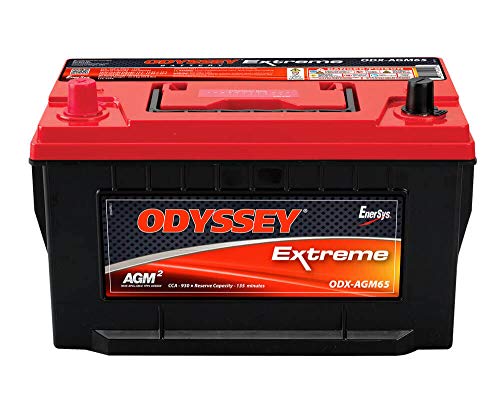
1. Odyssey ODX-AGM65 Extreme Series — Best Overall for Plow Duty
- Group size: 65
- Rating highlights: 950 CCA, 145 minutes reserve capacity, 74 Ah, TPPL AGM, SAE top posts
The Odyssey ODX-AGM65 is a Group 65 battery built on thin plate pure lead (TPPL) AGM technology, and it is the strongest all-round answer to plow work in this size. The current manufacturer data sheet rates it at 950 cold cranking amps, with a 1,750-amp pulse cranking rating for the first five seconds, 74 amp-hours of nominal capacity, and 145 minutes of reserve capacity. Those are big numbers for a Group 65 case, and they map directly onto plow duty: the pulse rating is what spins a cold diesel or a stiff gasoline V8 without drama, and the reserve capacity is what keeps the plow pump, spreader, and lights fed through a long night route.
TPPL construction also brings practical advantages that matter on a working truck. The pure lead plates resist corrosion, the AGM design is sealed and non-spillable, and the battery tolerates deeper discharge and recharges faster than a conventional flooded unit — important when the truck sits between storms and then works hard for twelve hours straight. Odyssey rates the Extreme series for high vibration resistance, which suits a truck that spends its life on rough lots and frozen rutted roads. The trade-offs are weight and the fact that this is a premium-positioned battery; qualitatively, it sits at the top of the group in capability, and for a truck that earns money per storm, that capability is the point.
2. XS Power D6500 — Best Reserve Capacity for Winch and Accessory Loads
- Group size: 65 format
- Rating highlights: 968 CCA, 174 minutes reserve capacity, AGM, M6 terminals (adapters may be needed)
The XS Power D6500 comes out of the high-output audio and performance world, but its numbers make it a serious plow truck battery. It is a Group 65-format AGM power cell, and XS Power’s own documentation rates it at 968 CCA with a reserve capacity of 174 minutes — the largest endurance figure in this guide — and a maximum output rating of 3,800 amps. That combination is aimed squarely at sustained heavy draws: exactly the profile of a winch recovering a stuck truck, or a plow pump and spreader cycling for hours.
The D6500 uses M6 terminal hardware rather than conventional SAE posts, so most trucks will need the appropriate post adapters or terminal hardware to connect factory cables; check what your truck requires before ordering, and budget the few minutes the conversion takes into the installation. Its sealed AGM case is spill-proof and vibration resistant. If your plow truck also runs a winch, auxiliary lighting, and a spreader — the full accessory stack — the D6500’s reserve capacity is the reason to pick it over a pure starting battery.
3. OPTIMA YellowTop D34/78 — Best Dual-Purpose Cycling Battery
The OPTIMA YellowTop D34/78 is the classic dual-purpose answer for trucks with heavy accessory loads. It is rated at 750 CCA with 55 amp-hours of capacity and 120 minutes of reserve capacity, and unlike a pure starting battery it is explicitly designed to be cycled: OPTIMA builds the YellowTop line for vehicles with winches, plows, lighting, and other high-draw equipment, and warrants it for that dual-purpose use. The 34/78 case gives you both top SAE posts and GM-style side terminals in one battery, which simplifies fitment across a mixed fleet and makes adding accessory connections easier.
The Spiralcell AGM construction is sealed, maintenance-free, and can be mounted in almost any position, and OPTIMA rates it as highly resistant to vibration — a genuine concern on a truck whose front end carries a plow frame and takes repeated shocks as the blade trips over curbs and frozen ground. Its raw cranking figure is lower than the Odyssey’s, so on a hard-starting diesel in extreme cold the Odyssey is the stronger pick; but for a gasoline plow truck that cycles its battery hard every route, the YellowTop’s deep-cycle tolerance is exactly the trait that keeps it alive season after season.
- Group size: 34/78
- Rating highlights: 750 CCA, 120 minutes reserve capacity, 55 Ah, dual top and side terminals, AGM Spiralcell
4. OPTIMA RedTop 34/78 — Best Pure Starting Battery on a Tighter Budget
- Group size: 34/78
- Rating highlights: 800 CCA, 100 minutes reserve capacity, 50 Ah, dual top and side terminals, AGM Spiralcell
The OPTIMA RedTop 34/78 is the starting specialist of the group: 800 cold cranking amps, 50 amp-hours, and 100 minutes of reserve capacity in the same dual-terminal 34/78 case as the YellowTop. For a plow truck that plows its own yard and a few driveways, starts several times a day, and does not run a winch, the RedTop delivers strong, fast cranking and the same sealed, vibration-resistant Spiralcell construction as its YellowTop sibling, at a qualitatively lower position in the OPTIMA range.
Be honest about the limitation, though: OPTIMA itself positions the RedTop as a starting battery and does not recommend it for deep-cycle applications. If your route is long, your plow cycles constantly, or a winch is fitted, the repeated deep draws will shorten a RedTop’s life, and the YellowTop or Odyssey above is the better spend. Choose the RedTop when starting performance is the main job and accessory loads are light, and it will do that job very well.
Comparison at a Glance
| Battery | Group | CCA | Reserve capacity | Best for |
|---|---|---|---|---|
| Odyssey ODX-AGM65 | 65 | 950 | 145 min | Maximum cranking and all-round plow duty |
| XS Power D6500 | 65 format | 968 | 174 min | Winch and heavy accessory endurance |
| OPTIMA YellowTop D34/78 | 34/78 | 750 | 120 min | Deep cycling from plow and spreader loads |
| OPTIMA RedTop 34/78 | 34/78 | 800 | 100 min | Strong starting, light accessory loads |
Supporting the Battery: Charging and Wiring
The best battery will still fail early if the rest of the system is weak. Plow trucks spend long periods at idle and low road speed, where alternator output is at its lowest, while the plow pump demands peak current. Three supporting steps make a measurable difference. First, keep the terminals and grounds clean and tight; the ground strap to the frame and the plow’s own power cables are frequent hidden causes of slow cranking and lazy blade movement. Second, use a quality AGM-compatible maintainer between storms — a smart charger that can fully recharge a deeply worked battery overnight will repay its cost in battery life, because an AGM battery left partially charged through the off-season sulfates and loses capacity. Third, if your truck works commercially, ask an auto electrician about your alternator output; many plow installers pair a battery upgrade with a higher-output alternator for exactly this reason.
Also plan for the dual-battery question if you run a diesel. Two matched batteries in parallel share both the cranking load and the accessory load, which is why diesel trucks ship that way. Replace them as a pair, keep them the same model and age, and never let one tired battery hide behind one new one — the pair will only perform to the level of the weaker unit, and the new battery will be overworked trying to compensate.
How to Choose
Start with fitment: confirm your group size, terminal layout, and hold-down style. Then rank by duty. If your truck is a diesel or starts in genuinely severe cold, put CCA first and take the Odyssey. If a winch and a full accessory stack define your work, put reserve capacity first and take the XS Power or the YellowTop. If the truck plows occasionally and starts often, the RedTop covers you. In every case, AGM dual-purpose construction is the through-line: plowing is cycling work, and the battery you choose has to be built to cycle, not just to start.
Finally, check the date code on any battery you receive, buy from a seller with fresh stock, and register the warranty. A plow truck battery is storm insurance; the time to discover a weak one is in your driveway in November, not in a customer’s lot in February.