Our Short List of 3

- Best for: Routine tissue disruption in conical tubes and small vessels, up to 50 mL per run.
- Rotor-stator tissue homogenizer, model 985370-XL
- Sized for samples from 1 to 50 mL
- Speed range from 5,000 to 35,000 rpm
- Runs on 120 VAC

- Best for: Cell lysis and grinding in microtubes, where sealed tubes and quick cycles matter most.
- Bead-beating microtube homogenizer
- Holds 3 x 2.0 mL non-skirted screw cap microtubes
- Variable speed from 2,800 to 4,000 rpm
- Timer from 3 seconds to 3 minutes
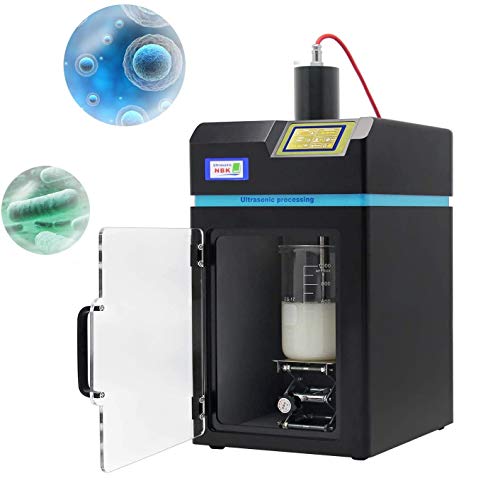
- Best for: Tough cells, fine emulsions, and nanoparticle dispersions across a wide volume range.
- Ultrasonic sonicator processor for cell disruption, emulsification and dispersion
- 1000W configuration
- 24 kHz frequency with automatic tracking across 19 to 26 kHz
- Handling capacity from 0.1 to 1200 mL
All 4 Picks at a Glance
| Product | Specs | Action |
|---|---|---|
| BioSpec Tissue-Tearor 985370-XL |
| Check price on Amazon |
| Benchmark Scientific BeadBug D1030 |
| Check price on Amazon |
| CGOLDENWALL 2 in 1 Ultrasonic Homogenizer |
| Check price on Amazon |
 MXBAOHENG FSH-2A |
| Check price on Amazon |
Key takeaways
- Compare five laboratory homogenizers for sample preparation, covering rotor-stator, bead, and ultrasonic models, volumes, speeds, and parts.
A homogenizer is a sample preparation instrument, so the buying decision turns on fit between mechanism and sample rather than raw power alone. A rotor-stator shears tissue in an open vessel, beads smash cells inside sealed microtubes, and an ultrasonic probe breaks tough material through cavitation. The five models below cover all three mechanisms, and each one was corroborated indirectly from a dedicated homogenizer roundup on another site, so every ASIN below carries a warning marker and needs a live re-check before ordering.
Three of the five listings state only a brand and model name in the short listing title used for corroboration, with the homogenizer wording carried in the listing-derived specification wording quoted in each product section. That basis is stated openly wherever it applies, and no listing is described with wording its own listing does not support. Because homogenization is itself sample preparation, the sample preparation element rests on the homogenizer form stated for each pick, and no separate sample preparation claim is made for any listing.
Quick Picks
As an Amazon Associate we earn from qualifying purchases.
| Product | Best for | Key spec from title |
|---|---|---|
| PRO Scientific Bio-Gen PRO200 Homogenizing Package | Handheld tissue work in tubes and small beakers | 5,000 to 35,000 rpm, saw-tooth probe included |
| BioSpec Tissue-Tearor 985370-XL | Small tissue samples in buffer | 1 to 50 mL samples, 10.9 cm probe |
| Benchmark Scientific BeadBug D1030 | Cell lysis inside microtubes | Holds 3 x 2.0 mL tubes, 2,800 to 4,000 rpm |
| CGOLDENWALL 2 in 1 Ultrasonic Homogenizer | Tough cells and fine dispersions | 24 kHz, 0.1 to 1200 mL handling capacity |
| MXBAOHENG FSH-2A | Emulsions and dispersions up to a litre | 5 to 1000 mL, two working heads included |
How to Choose
Match the mechanism to your sample
Rotor-stator units pull sample through a slotted probe and shear it mechanically, which suits soft tissue, resuspended pellets, and emulsions in open vessels where you can watch and guide the process by hand. Bead homogenizers shake sealed tubes with hard beads, so nothing touches the sample except the beads, which suits cell lysis and grinding while keeping samples apart. Ultrasonic units deliver energy through a metal horn and excel with tough cells and nanoparticle dispersions. Begin by naming your hardest routine sample, then pick the mechanism built for it rather than the one with the biggest motor figures.
Check the working volume range
Every homogenizer has a volume window where it works well, and working outside that window causes real problems. A probe sized for 50 mL will splash and foam in a 5 mL tube, while a microtube bead unit cannot touch a 500 mL batch at all. List your smallest and largest routine batches, including the vessel you actually use, and confirm the listing covers both ends of that range. Probe diameter, tube capacity, and vessel shape all matter here, so match the full setup to your bench routine, not just the headline litre figure in the listing title.
Look at speed control and run timing
Fine speed control matters because delicate samples shear apart at low settings while fibrous tissue needs full power in short bursts, and a wide adjustable range lets one unit serve both kinds of work. A built-in timer or cycle program helps when you run the same protocol many times a day, and rest periods between cycles limit heat buildup in temperature-sensitive work. Check how speed is set, whether the setting holds steady under load, and how long the unit may run before it needs a pause. Heat is the quiet failure mode in this class, so timing controls deserve as much attention as top speed.
Plan for probes, beads, and cleaning
The purchase does not end with the drive unit, and the consumables decide the real running cost. Rotor-stator work needs the right probe diameter for each vessel, and probes must come apart for cleaning between samples. Bead units need a steady supply of prefilled tubes or bulk beads in the right material and size. Ultrasonic horns wear over time and are replaced as wear parts. Before ordering, confirm which of these items the box includes, which are sold separately, and how cleaning works for your sample type and workflow, so the first week of runs is not spent waiting on parts.
The 5 Best Options
PRO Scientific Bio-Gen PRO200 Homogenizing Package
This package pairs the Bio-Gen PRO200 hand-held rotor-stator drive with a saw-tooth generator probe, a combination aimed at tissue chunks, plant material, and stubborn pellets that resist gentler mixing. The saw-tooth profile tears fibrous pieces apart before the rotor-stator gap shears them fine, so samples reach a uniform suspension quickly. A wide speed range lets you begin slowly to keep liquid in the vessel, then climb toward full power once the sample breaks down. It suits labs that move between tubes and small beakers all day and want one handheld unit for varied bench work.
Specs
- Hand-held rotor-stator homogenizer built around the Bio-Gen PRO200 drive unit
- Saw-tooth generator probe included in the package
- Variable speed from 5,000 to 35,000 rpm
- 115V configuration
- Sold as the Standard Max-Homogenizing Package, code PRO-PK-01200MXS
Best for: Tissue and plant samples in tubes or small beakers, processed by hand at the bench.
Watch out for: Confirm the probe diameter in the box fits your narrowest vessel, and check whether a stand is included or sold separately for longer runs.
ASIN: ⚠ B004123V1S
BioSpec Tissue-Tearor 985370-XL
- Best for: Routine tissue disruption in conical tubes and small vessels, up to 50 mL per run.
- Rotor-stator tissue homogenizer, model 985370-XL
- Sized for samples from 1 to 50 mL
- Speed range from 5,000 to 35,000 rpm
- Runs on 120 VAC
Routine tissue disruption in conical tubes and small vessels, up to 50 mL per run.
Check which probe size the listing ships with, since this family offers several probe diameters and the wrong one changes results.
The Tissue-Tearor is a long-running name in small tissue work, and this XL listing is built around a probe with a 10.9 cm working length for samples between 1 and 50 mL. That reach suits tissue pieces sitting in buffer at the bottom of a conical tube, where a shorter probe would leave chunks untouched. The drive covers a broad speed span, so soft samples can be coaxed apart gently while denser pieces get full power. It fits labs that homogenize modest tissue volumes many times a day and value a simple, direct tool with no extra assemblies to manage.
Watch out for: Check which probe size the listing ships with, since this family offers several probe diameters and the wrong one changes results.
Benchmark Scientific BeadBug D1030
- Best for: Cell lysis and grinding in microtubes, where sealed tubes and quick cycles matter most.
- Bead-beating microtube homogenizer
- Holds 3 x 2.0 mL non-skirted screw cap microtubes
- Variable speed from 2,800 to 4,000 rpm
- Timer from 3 seconds to 3 minutes
Cell lysis and grinding in microtubes, where sealed tubes and quick cycles matter most.
It accepts non-skirted screw cap tubes only, so confirm your tube stock matches before ordering, and plan a bead supply in the sizes your samples need.
The BeadBug takes the sealed-tube route: up to three 2.0 mL screw cap microtubes, loaded with beads, are shaken hard enough that the beads pulverize cells and tissue inside. Because the sample never leaves its tube, cross-contamination between samples stays near zero and cleanup shrinks to discarding the tube. A timer handles runs from a few seconds to three minutes, which suits repeat lysis protocols for bacteria, yeast, and small tissue pieces. It is the natural pick when your samples already live in microtubes and throughput means many small tubes rather than large batches.
Watch out for: It accepts non-skirted screw cap tubes only, so confirm your tube stock matches before ordering, and plan a bead supply in the sizes your samples need.
CGOLDENWALL 2 in 1 Ultrasonic Homogenizer
- Best for: Tough cells, fine emulsions, and nanoparticle dispersions across a wide volume range.
- Ultrasonic sonicator processor for cell disruption, emulsification and dispersion
- 1000W configuration
- 24 kHz frequency with automatic tracking across 19 to 26 kHz
- Handling capacity from 0.1 to 1200 mL
Tough cells, fine emulsions, and nanoparticle dispersions across a wide volume range.
Confirm the wattage configuration and probe size on the listing before ordering, since this model family sells in several power and volume variants.
This ultrasonic unit takes a different route from every mechanical model here: a 24 kHz horn delivers energy straight into the liquid, disrupting cells and breaking droplets down to very fine dispersions. The 2 in 1 layout houses the processor in an integrated soundproof box with an LED light, which keeps bench noise down and lets you watch the sample during a run. Its handling range runs from a tenth of a millilitre to 1200 mL by swapping probes, so one unit covers micro samples and litre batches. It suits tough cells, emulsions, and nanoparticle work that defeats probes and beads.
Watch out for: Confirm the wattage configuration and probe size on the listing before ordering, since this model family sells in several power and volume variants.
MXBAOHENG FSH-2A
- Best for: Emulsions and dispersions in beakers, from small trials up to one-litre batches.
- High-speed homogenizer, disperser and emulsifier
- Working volume from 5 to 1000 mL
- Adjustable speed from 6,000 to 22,000 rpm
- Two working heads included
Emulsions and dispersions in beakers, from small trials up to one-litre batches.
Respect the duty cycle in the listing and let the motor rest between long runs, and confirm the head sizes match your vessel diameters.
The FSH-2A is a bench disperser-style homogenizer for labs whose work leans toward emulsions, suspensions, and cosmetic or food-style batches rather than microtubes. It covers 5 to 1000 mL, and the box carries two working heads, so you can swap between a head suited to breaking down solids and one tuned for finer emulsifying without a second purchase. Speed adjusts across a broad band, which helps when a batch must be built up gradually to avoid foam. For a teaching or product-development bench that mixes all day, this layout keeps things simple and avoids a second unit.
Watch out for: Respect the duty cycle in the listing and let the motor rest between long runs, and confirm the head sizes match your vessel diameters.
Which One Fits Your Situation
You lyse cells in microtubes all day
Choose the Benchmark Scientific BeadBug D1030. Your samples already sit in 2.0 mL tubes, and the BeadBug keeps them sealed while beads do the work, so lysis stays consistent from tube to tube and cleanup is minimal. Its timer supports repeat protocols, and three tubes per run matches a steady bench rhythm without forcing you into larger vessels you do not use.
You break down tissue chunks in buffer
Choose the PRO Scientific Bio-Gen PRO200 package if you move between tubes and beakers, since its saw-tooth probe handles fibrous pieces well by hand. Choose the BioSpec Tissue-Tearor instead if nearly all your work is 1 to 50 mL of tissue in conical tubes, where its longer probe reach fits the vessel and keeps chunks from settling out of reach.
You build emulsions and test batches
Choose the MXBAOHENG FSH-2A. Its two working heads and 5 to 1000 mL range cover small trials and litre-sized test batches in open vessels, and the adjustable speed lets you build an emulsion gradually. It fits product-development and teaching benches that mix formulations more often than they lyse cells in tubes.
Your samples resist mechanical methods
Choose the CGOLDENWALL 2 in 1 Ultrasonic Homogenizer. Ultrasonic energy handles tough cell walls, elastic material, and very fine dispersions that defeat probes and beads, and the soundproof box keeps long runs tolerable at the bench. Swap probes to move between small and large volumes on the same unit without buying twice.
Common Mistakes
- Choosing by top speed alone, when mechanism and probe or bead fit decide whether your sample processes at all.
- Running a rotor-stator probe in a vessel far wider or narrower than the probe diameter, which leaves dead zones and uneven results.
- Filling microtubes with skirted caps for a bead homogenizer that only accepts non-skirted screw cap tubes.
- Running long ultrasonic or rotor-stator cycles without rest periods, letting heat damage the sample mid-protocol.
- Ordering the drive unit without confirming which probes, heads, or bead tubes the box actually includes.
Frequently Asked Questions
What is the difference between rotor-stator and bead homogenizers?
A rotor-stator unit shears sample drawn through a slotted probe in an open vessel, so you watch and guide the process by hand. A bead homogenizer seals sample and beads inside a tube and shakes it hard, which keeps samples apart and suits lysis. Choose by vessel and sample type, not by power figures alone.
Can one homogenizer handle both tissue and cell cultures?
Often, yes, within limits. A variable-speed rotor-stator with the right probe can disrupt soft tissue and resuspend cultured cells on gentle settings. Very hard tissue, bone, or seed material belongs in a bead unit, and delicate work meant to keep cells alive needs low speeds and short bursts on any mechanism.
How do I keep samples from overheating during a run?
Work in short bursts with pauses between them, and set vessels in an ice bath for longer protocols. Bead units with timers make burst cycles easy to repeat. Heat builds fastest at top speed in small volumes, so lower the speed, split the batch, or chill the vessel whenever the sample feels warm.
What does the warning marker on each ASIN mean?
The warning marker means the code was corroborated indirectly, through a listing card on another site rather than a direct check of the Amazon product page, so it needs a live re-check before ordering. It does not mean the code is wrong, only that it was not verified firsthand here. Confirm the listing, model, and included parts on the live page before buying.