Our Short List of 3
- Best for: a small desktop UPS protecting a router, modem, network switch or a low-power computer, where the load stays modest and the original battery was a small sealed lead-acid unit.
- ASIN: B09H3FG1D5 (2-pack listing, Amazon US)
- Evidence level: Candidate. Amazon product page could not be read directly because Amazon returned an access-denied response to the fetch, so this is based on the indexed Amazon listing and a third-party listing tracker that recorded the product as available in November 2026 with a large number of customer ratings. Live verification before purchase is still recommended.

- Best for: a home office UPS carrying a desktop computer, a monitor and networking gear, where the extra capacity buys meaningful runtime and the 20 amp discharge limit covers the load.
- ASIN: B09NB97XGL (Amazon US)
- Evidence level: Candidate. Amazon product page could not be read directly because Amazon returned an access-denied response to the fetch, so this is based on the indexed Amazon listing, the maker datasheet, and third-party coverage. Live verification before purchase is still recommended.
- Best for: a large UPS or an external battery bank backing up a workstation, a small server, or a home office through a long outage, where capacity and discharge headroom matter more than compact size.
- ASIN: B0FDQL2J9R (Amazon US)
- Evidence level: Candidate. Amazon product page could not be read directly because Amazon returned an access-denied response to the fetch, so this is based on the indexed Amazon listing, which showed the product in stock and sold by the brand at the time of the crawl. Live verification before purchase is still recommended.
All 3 Picks at a Glance
| Product | Specs | Action |
|---|---|---|
| 1. NERMAK 12V 10Ah LiFePO4 Battery, 2-Pack |
| Check price on Amazon |
| 2. ECO-WORTHY 12V 20Ah LiFePO4 Battery |
| Check price on Amazon |
| 3. CYCLENBATT 12V 100Ah Mini Bluetooth LiFePO4 Battery |
| Check price on Amazon |
Key takeaways
- Compare the best lithium batteries for UPS backup: LiFePO4 12V replacements in 10Ah, 20Ah and 100Ah sizes, with compatibility checks for chargers, terminals and load limits.
Affiliate Disclosure: As an Amazon Associate, we earn from qualifying purchases made through links in this article, at no extra cost to you.
Introduction: What a Lithium Battery for a UPS Really Is
When someone searches for the best lithium battery for a UPS, they usually mean one of two things, and the distinction matters before any money changes hands. The first is a replacement battery: a 12 volt lithium iron phosphate, or LiFePO4, battery that goes inside an existing uninterruptible power supply in place of the sealed lead-acid battery it shipped with. The second is a complete lithium UPS unit, a finished box with outlets, an inverter and a built-in lithium pack. This guide covers the first meaning, the replacement battery, because that is where most buyers actually land. Swapping the internal battery is the cheaper path to longer backup time and a much longer service life, but only when the replacement genuinely matches the UPS it goes into.
A UPS is not a generic battery holder. Its charger, its inverter, its low-voltage cutoff and its alarm thresholds were all tuned for the lead-acid battery it came with. A lithium battery behaves differently on every one of those points. Get the match right and you gain thousands of charge cycles, a lighter battery, and usable capacity that stays steady until the pack is nearly empty. Get it wrong and the UPS may refuse to charge the battery fully, shut down early, or trigger its protection circuits at the worst possible moment.
Why LiFePO4 Is the Lithium Chemistry for UPS Duty
Most lithium batteries sold as 12 volt replacements use lithium iron phosphate chemistry, shortened to LiFePO4 or LFP. There is a reason for that. Compared with the lithium-ion chemistry in phones and laptops, LiFePO4 is thermally stable, tolerates being held at full charge for long periods, and delivers a flat discharge curve, which means the voltage stays close to its nominal level for most of the discharge and then drops sharply near the end. For a UPS that powers a computer or a router during an outage, that flat curve is useful: connected equipment sees steady voltage rather than a slow sag.
Cycle life is the other headline advantage. The batteries in this guide are rated by their makers for roughly two thousand to four thousand deep cycles, against a few hundred cycles for a typical sealed lead-acid UPS battery. In a home or small office where the UPS mostly sits on standby and only cycles during real outages, that difference can mean a battery that lasts many years instead of two or three. LiFePO4 batteries are also lighter than lead-acid batteries of the same capacity, often by half or more, and they need no watering or equalisation maintenance.
The Compatibility Checks That Decide Whether a Swap Works
Check the UPS charger voltage first
A 12 volt LiFePO4 battery has a nominal voltage of about 12.8 volts and charges to about 14.4 to 14.6 volts. A UPS designed for sealed lead-acid batteries typically charges to a lower float voltage, often around 13.6 to 13.8 volts. That is usually enough to charge a LiFePO4 battery to a large part of its capacity, but it may never reach a full charge, and the UPS battery gauge may read low even when the pack is nearly full. Read the UPS manual for its charging voltage and for any statement about lithium batteries. If the maker says lithium is not supported, that warning should be treated as decisive rather than as a suggestion.
Match the discharge current to the load
Every LiFePO4 battery has a continuous discharge limit set by its BMS. A small 10 amp-hour battery with a 10 amp BMS can deliver about 120 watts continuously at 12 volts, which suits a router, a modem and a small monitor, but not a gaming computer and a large display. A 20 amp-hour battery with a 20 amp BMS roughly doubles that ceiling, and a 100 amp-hour battery with a 100 amp BMS covers far larger loads. Add up the wattage of everything the UPS will carry during an outage, leave a margin, and choose a battery whose continuous discharge rating covers that total. Exceeding the BMS limit can cause the battery to cut off without warning, which is exactly the failure a UPS exists to prevent.
Respect the VA and wattage limit in the listing
Some battery makers state a maximum UPS size for their product. NERMAK, for example, states that its 10 amp-hour battery is not for use in a UPS above 1500 VA or 1000 watts. That is a clear, useful limit, and it should be followed. A small battery in a large UPS is a mismatch in both directions: the UPS can demand more current than the BMS allows, and the battery can run down in minutes under a load it was never sized for.
Match terminals, dimensions and mounting
UPS battery compartments are tight, and the original battery is usually a standard size such as the common 7 amp-hour or 9 amp-hour sealed lead-acid format. Measure the compartment and compare it with the replacement battery dimensions before ordering. Terminal style matters just as much: F2 spade terminals, M5 screw terminals and M8 bolt terminals are not interchangeable without adapters, and a loose or improvised connection inside a UPS is a fire risk. Check whether the battery can be mounted in the orientation your UPS requires, since some UPS units hold the battery on its side.
Expect the runtime display to be wrong
A UPS estimates remaining runtime from the voltage curve of a lead-acid battery. Because a LiFePO4 battery holds its voltage almost flat and then drops quickly, the UPS display may show a generous runtime right up to the moment the battery disconnects. Treat the display as a rough guide after a swap, not as a precise countdown. The practical fix is to test the real runtime with a controlled outage before trusting the setup with important work.
How to Size Capacity for Your Load
A practical way to size is to work backwards from the load. A router and modem drawing a modest load can run for hours on a 20 amp-hour battery. A desktop computer with a monitor drawing several hundred watts will drain the same battery in well under an hour. If your goal is simply to ride through brief outages and shut down gracefully, a smaller battery is enough. If your goal is to keep working through a long outage, you need a larger battery, and you should confirm that the UPS charger can recharge it in a reasonable time afterwards.
The Picks
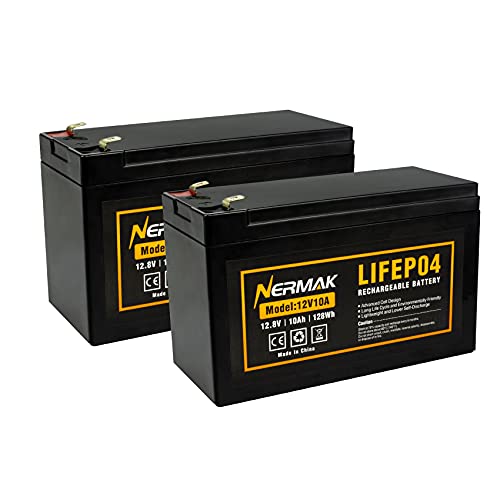
1. NERMAK 12V 10Ah LiFePO4 Battery, 2-Pack
- Best for: a small desktop UPS protecting a router, modem, network switch or a low-power computer, where the load stays modest and the original battery was a small sealed lead-acid unit.
- ASIN: B09H3FG1D5 (2-pack listing, Amazon US)
- Evidence level: Candidate. Amazon product page could not be read directly because Amazon returned an access-denied response to the fetch, so this is based on the indexed Amazon listing and a third-party listing tracker that recorded the product as available in November 2026 with a large number of customer ratings. Live verification before purchase is still recommended.
a small desktop UPS protecting a router, modem, network switch or a low-power computer, where the load stays modest and the original battery was a small sealed lead-acid unit.
the 10 amp continuous limit. A larger UPS or a load with a high inrush current can trip the BMS. Confirm the terminal type and the compartment dimensions, and remember that the listing recommends a LiFePO4-specific charger for full charging, so a UPS charger tuned for lead-acid may leave the battery short of a full charge.
The NERMAK 12V 10Ah is the smallest pick here, and it is the most direct replacement for the small sealed lead-acid batteries found in compact desktop UPS units. Each battery in the two-pack is rated at 12.8 volts and 10 amp-hours, giving about 128 watt-hours per battery, with a built-in 10 amp BMS and a stated cycle life above two thousand cycles. Dimensions are about 5.94 by 2.56 by 3.7 inches, and each battery weighs about 2.64 pounds, so it fits compartments built around the common small lead-acid format and is far lighter than the battery it replaces. Terminals are F2 spade type, which matches many small UPS units.
The listing names small UPS use among its applications, alongside lighting, fish finders, routers and ride-on toys. It also states the limits clearly: the battery is not a starter battery, and it is not for use in a UPS above 1500 VA or 1000 watts, because its continuous discharge is 10 amps. Two batteries can be connected in series or in parallel, up to four in either arrangement according to the maker.
Watch out for: the 10 amp continuous limit. A larger UPS or a load with a high inrush current can trip the BMS. Confirm the terminal type and the compartment dimensions, and remember that the listing recommends a LiFePO4-specific charger for full charging, so a UPS charger tuned for lead-acid may leave the battery short of a full charge.
2. ECO-WORTHY 12V 20Ah LiFePO4 Battery
- Best for: a home office UPS carrying a desktop computer, a monitor and networking gear, where the extra capacity buys meaningful runtime and the 20 amp discharge limit covers the load.
- ASIN: B09NB97XGL (Amazon US)
- Evidence level: Candidate. Amazon product page could not be read directly because Amazon returned an access-denied response to the fetch, so this is based on the indexed Amazon listing, the maker datasheet, and third-party coverage. Live verification before purchase is still recommended.
a home office UPS carrying a desktop computer, a monitor and networking gear, where the extra capacity buys meaningful runtime and the 20 amp discharge limit covers the load.
the M5 screw terminals may not match a UPS wired for F2 spade terminals, so check the connector before ordering. As with any LiFePO4 swap, the UPS charger may not fully charge the pack, and the runtime display may be optimistic.
The ECO-WORTHY 12V 20Ah doubles the capacity of the NERMAK pick and suits a mid-size UPS that protects a desktop computer and a monitor. It is rated at 12.8 volts and 20 amp-hours, with a built-in BMS, a maximum discharge current of 20 amps, and a cycle life stated at four thousand cycles on the Amazon listing, with the maker datasheet giving a range of three thousand to five thousand cycles. It measures about 221 by 113 by 117 millimetres and weighs about 2.2 kilograms, with M5 screw terminals. The maker datasheet lists a standard charge current of 10 amps, a maximum charge current of 20 amps, a discharge cutoff around 10 volts, and support for series and parallel connection of multiple batteries.
That 20 amp discharge ceiling is the key difference from the smaller pick: it roughly doubles the continuous load the battery can sustain, which makes it a better fit for a computer that draws real power rather than just a router. The maker certifies the battery to UN38.3 and lists UL 2271 and CE compliance in third-party coverage of the product, and the datasheet states a self-discharge rate of about three percent per month, which matters for a battery that spends most of its life on standby.
Watch out for: the M5 screw terminals may not match a UPS wired for F2 spade terminals, so check the connector before ordering. As with any LiFePO4 swap, the UPS charger may not fully charge the pack, and the runtime display may be optimistic.
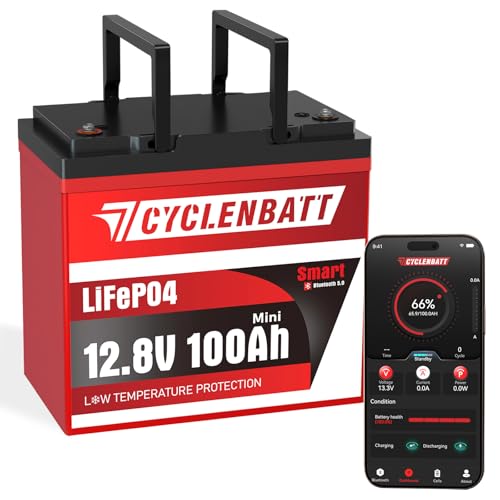
3. CYCLENBATT 12V 100Ah Mini Bluetooth LiFePO4 Battery
- Best for: a large UPS or an external battery bank backing up a workstation, a small server, or a home office through a long outage, where capacity and discharge headroom matter more than compact size.
- ASIN: B0FDQL2J9R (Amazon US)
- Evidence level: Candidate. Amazon product page could not be read directly because Amazon returned an access-denied response to the fetch, so this is based on the indexed Amazon listing, which showed the product in stock and sold by the brand at the time of the crawl. Live verification before purchase is still recommended.
a large UPS or an external battery bank backing up a workstation, a small server, or a home office through a long outage, where capacity and discharge headroom matter more than compact size.
size and weight. Measure carefully, because this battery will not fit a standard desktop UPS compartment. Also confirm that the UPS charger can recharge a 100 amp-hour pack in a sensible time, and check the low-temperature behaviour if the battery will sit in a cold space.
The CYCLENBATT 12V 100Ah Mini is the large-capacity pick, intended for big UPS setups and external battery arrangements where runtime is measured in hours rather than minutes. It is rated at 12.8 volts and 100 amp-hours, with a built-in 100 amp smart BMS, Bluetooth monitoring through a mobile app, and low-temperature charging protection. It weighs about 20.83 pounds and uses M8 terminals. The compact mini format is smaller than many 100 amp-hour LiFePO4 batteries, though it is still far larger than the battery in a typical desktop UPS and belongs in a large UPS or an external battery pack rather than a compact unit.
The 100 amp BMS is what makes this battery credible for large loads: it can sustain far more current than the smaller picks, and the Bluetooth monitoring lets you check state of charge, voltage and temperature from a phone instead of guessing from the UPS display, which is a real advantage given that a UPS runtime estimate is unreliable after a lithium swap, as explained in the compatibility section above. Low-temperature protection is also relevant for a battery installed in a garage or an unheated room, since charging a lithium battery below freezing can damage it.
Watch out for: size and weight. Measure carefully, because this battery will not fit a standard desktop UPS compartment. Also confirm that the UPS charger can recharge a 100 amp-hour pack in a sensible time, and check the low-temperature behaviour if the battery will sit in a cold space.
Quick Comparison
| Battery | Capacity | Continuous discharge | Terminals | Best UPS size |
|---|---|---|---|---|
| NERMAK 12V 10Ah, 2-pack | 10Ah per battery | 10A | F2 spade | Small desktop UPS, up to 1500 VA |
| ECO-WORTHY 12V 20Ah | 20Ah | 20A | M5 screw | Mid-size home office UPS |
| CYCLENBATT 12V 100Ah Mini | 100Ah | 100A | M8 bolt | Large UPS or external battery bank |
Installation and Safety Notes
Disconnect the UPS from mains power and switch it off before opening the battery compartment. Note the polarity of the existing connections and photograph them before removing anything, since reversed polarity can destroy the UPS or the battery. Connect the replacement battery with the correct polarity, secure it so it cannot move, and check that terminals are tight and insulated.
Charge the new battery before relying on it. A UPS charger may take a long time to bring a LiFePO4 battery to full charge, and a large pack may need a dedicated LiFePO4 charger for its first full charge. After installation, run a controlled test: unplug the UPS from the wall with the real load connected, time how long it actually supports the load, and confirm that the connected equipment shuts down gracefully. Repeat that test every few months.
Treat safety warnings seriously. Do not puncture, crush or short-circuit a lithium battery. Do not charge a LiFePO4 battery below freezing unless the battery and its BMS explicitly support low-temperature charging. Do not use a lithium battery as a starter battery, and do not connect batteries of different capacities, ages or chemistries together. If a battery swells, smells unusual, or becomes hot during charging, disconnect it and contact the seller.
Frequently Asked Questions
Can I replace any UPS battery with lithium?
No. Only replace the battery when the UPS manual allows it or when you have confirmed that the charger voltage, the battery dimensions, the terminal type and the discharge limits all match. Some UPS makers state plainly that lithium batteries are not supported, and that guidance should be followed.
Will a lithium battery last longer than the lead-acid battery it replaces?
In cycle life, yes, by a wide margin. The LiFePO4 batteries in this guide are rated for thousands of cycles, while a sealed lead-acid UPS battery is typically rated for a few hundred. In calendar life on standby duty, a lithium battery should also outlast lead-acid, provided the charger and the BMS are compatible with the UPS.
Do I need a special charger for a LiFePO4 UPS battery?
For a full charge, a LiFePO4-specific charger is recommended by the battery makers. A UPS charger tuned for lead-acid will often charge the battery most of the way, but it may not reach the top of the charge, and it will not balance the cells. If the UPS is the only charger available, accept that the battery may sit below full charge, and check the maker guidance for your model.
Is a bigger battery always better for a UPS?
Not necessarily. A larger battery gives longer runtime, but it also takes longer to recharge, may not fit the compartment, and can demand more current than a small UPS is designed to handle. Size the battery to the load and to the UPS charger, not just to the longest runtime you can imagine.
Conclusion
The best lithium battery for a UPS is the one that matches the UPS you already own: the right voltage, the right terminals, the right physical size, a discharge limit that covers the real load, and a charger that can actually fill it. For a small desktop UPS protecting networking gear, the NERMAK 12V 10Ah two-pack is the natural fit, with a clearly stated limit of 1500 VA. For a home office computer and monitor, the ECO-WORTHY 12V 20Ah doubles both capacity and discharge headroom. For a large UPS or an external bank where runtime is measured in hours, the CYCLENBATT 12V 100Ah Mini brings the capacity and the 100 amp BMS to match.
Whichever size you choose, do the compatibility checks first, test the real runtime after installation, and verify the listing is in stock on Amazon US before ordering, since availability for these batteries changes frequently.