Our Short List of 3
All 4 Picks at a Glance
| Product | Specs | Action |
|---|---|---|
 COMFEE’ CDC22P2AWW Countertop Dishwasher | Check price on Amazon | |
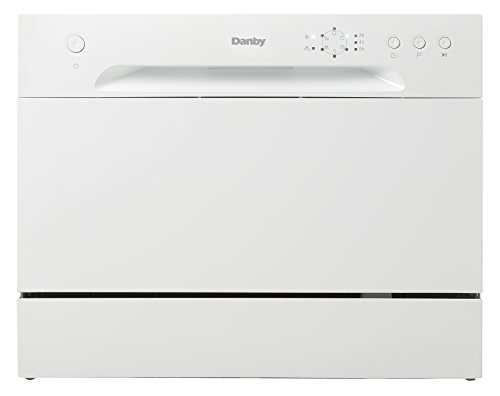 Danby DDW621WDB Countertop Dishwasher | Check price on Amazon | |
 COMFEE’ CDC17P2AWW Countertop Dishwasher | Check price on Amazon | |
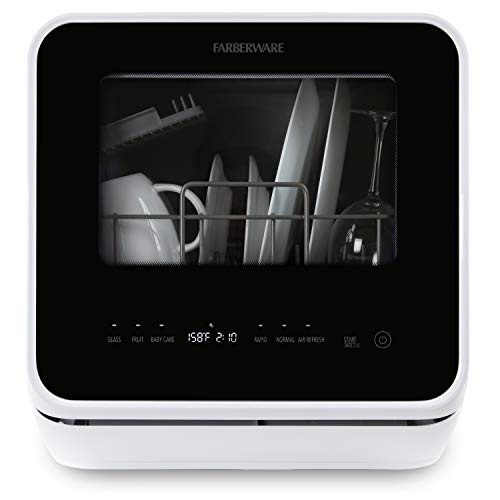 Farberware FDW05ASBWHA Countertop Dishwasher | Check price on Amazon |
Key takeaways
- The best dishwashers for apartments are compact countertop models: tank-fed or faucet-connected, quiet-running, and sized for small rental kitchens and dorms.
Most apartments rule out a standard built-in dishwasher: the cabinets are not yours to cut, the lease forbids plumbing changes, and the kitchen may not even have a spare cupboard bay. The machines that work in this situation are countertop dishwashers — compact units that either fill from a built-in water tank or connect to the kitchen faucet with a removable adapter, then drain into the sink. Nothing is plumbed in permanently, so the machine can move out with you. This guide compares four countertop models sold on Amazon US that suit apartment living, from two-place-setting tank models for solo renters to six-place-setting faucet models for couples and small shared flats.
Disclosure: As an Amazon Associate, we earn from qualifying purchases. Product details and availability can change; check the Amazon listing before you buy.
Every pick below was chosen from manufacturer specifications and Amazon listing details for the exact model, so the capacities, dimensions and cycle lists are the makers’ published numbers. The shortlist splits along one decision: a tank-fed machine that needs no faucet access, or a larger faucet-connected machine that trades a hose connection for roughly triple the capacity.
Quick picks at a glance
| Product | ASIN | Best for |
|---|---|---|
| COMFEE’ CDC22P2AWW Countertop Dishwasher | B096RYWSQM | Couples and small households that can use a faucet hookup |
| Danby DDW621WDB Countertop Dishwasher | B01I6MHNQC | Quiet running and a stainless steel interior |
| COMFEE’ CDC17P2AWW Countertop Dishwasher | B09QC9947J | Renters with no faucet access who still want powered drying |
| Farberware FDW05ASBWHA Countertop Dishwasher | B07VR22832 | Solo renters and the smallest counters |
What matters most for apartment living
Footprint and cabinet clearance. Countertop dishwashers stand roughly 17 to 18.5 inches tall, which is close to the gap under many wall cabinets. Measure the vertical clearance on your counter before ordering, and check the width and depth too — the six-place-setting models are about 21.6 inches wide and need room behind them for hoses. A machine that fits on paper but blocks a cabinet door will annoy you daily.
How it gets water. Tank models carry a built-in reservoir (5 to 6 liters here) that you fill with a pitcher, so they can run anywhere near an outlet and a sink for draining — useful when the faucet is an odd shape, has a pull-down sprayer, or is shared in a studio layout. Faucet models connect with a quick-connect adapter whenever you wash; they hold more dishes but tie up the tap during the cycle and need a faucet with a removable aerator.
Capacity in place settings. Two-place-setting tank models handle one person’s daily dishes or a couple’s light load. Six-place-setting models take up to 70 pieces of tableware and plates around 10 inches across, which covers most dinners for two or three people. Pots and oven trays rarely fit in either class, so expect to keep washing those by hand.
Noise. Apartment walls are thin and kitchens are often open-plan. The figures in this guide run from 49 to 62 decibels, so if the machine will run in the room where you work or sleep, the quieter end of that range matters more than an extra cycle.
Water and energy use. Countertop units use far less water per load than a full-size machine — from about 1.6 gallons per cycle on the smallest tank model to around 3.1 gallons on the largest pick here. Where utilities are billed separately or the building has older plumbing, those low per-cycle figures are a practical advantage.
Move-out friendliness. Nothing in this guide requires drilling, hard-wiring or a water line. Every pick plugs into a standard 120-volt outlet, weighs between about 36 and 46 pounds, and can be lifted off the counter and boxed when the lease ends.
COMFEE’ CDC22P2AWW Countertop Dishwasher
The CDC22P2AWW is the fullest-featured faucet-connected model in this guide: six place settings, eight wash programs and an extra-dry function, in a cabinet that still sits on a countertop. For an apartment shared by two or three people, it is the closest thing here to a conventional dishwasher routine.
Why it fits apartment living. The eight programs include a 45-minute Speed cycle for lightly soiled loads and a Baby-Care high-temperature cycle, and the Heavy program uses 12 wash nozzles with a 360-degree spiral spray for baked-on food. The delay timer of up to 24 hours lets you load after dinner and run the machine overnight or while you are out, which suits thin-walled buildings. It can also be fitted inside a cupboard.
Trade-offs. At 46 pounds and nearly 22 inches wide, it is a permanent countertop resident rather than something you stash away between washes. It has no water tank, so a compatible faucet and adapter are mandatory, and the tap is occupied while it runs.
Best for / Skip if. Best for couples and small shared flats that cook most days and have a standard threaded faucet. Skip it if your faucet cannot take an adapter or your counter clearance is under 17.2 inches.
Danby DDW621WDB Countertop Dishwasher
Danby’s DDW621WDB is the established six-place-setting option in this class, built around a stainless steel interior, six straightforward cycles and a delay start. Its 52-decibel operation figure makes it a sensible pick for open-plan studios where the kitchen is also the living room.
Why it fits apartment living. The quick-connect feature works with most kitchen faucets, and the delay start means you can set a load going after you leave for work rather than listening to it in the evening. The stainless steel interior resists staining and odors better than plastic tubs over years of use — relevant if you plan to carry the same machine through several leases.
Trade-offs. Like the COMFEE’ above, it is faucet-only with no tank fallback, and at 46.3 pounds it is not a machine you will move often. The control layout is simpler than the COMFEE’s, with fewer specialty cycles.
Best for / Skip if. Best for studio and one-bedroom renters who want a durable interior and quieter running for daily loads. Skip it if you need a tank model because your faucet is incompatible with adapters.
COMFEE’ CDC17P2AWW Countertop Dishwasher
The CDC17P2AWW removes the faucet from the equation: its built-in 6-liter water tank lets it run anywhere with an outlet and a sink to drain into, and a quick-connect hose is still included if you later prefer a faucet feed. It adds two features rarely seen on tank models — a UV hygiene program and an auto-open door at the end of the cycle for better drying.
Why it fits apartment living. No faucet compatibility questions, no adapter left screwed onto the tap, and no conflict with a landlord over fixtures — you fill the tank, run the load, and drain into the sink. The auto-open door addresses the main weakness of small tank machines, dishes that stay damp, and the UV hygiene program suits renters washing baby bottles or shared-house glassware. An overflow switch cuts off water if it detects a leak, a reassuring detail in a rental.
Trade-offs. Two place settings is a hard ceiling — this is a one-to-two-person machine, and the tank needs refilling for every load. At 62 dB it is the loudest pick in this guide, and at 18.3 inches tall it may not fit beneath low wall cabinets even though its footprint is small.
Best for / Skip if. Best for solo renters and couples in buildings with unusual faucets, strict fixture rules, or no spare tap access. Skip it if you regularly cook for three or more, or if your under-cabinet clearance is tight.
Farberware FDW05ASBWHA Countertop Dishwasher
The Farberware is the smallest and lightest machine in this guide — a two-place-setting tank model that fits dishes up to 12 inches in diameter despite its compact body. It is designed for exactly the apartment scenario: set it on any countertop or sturdy table, fill the 5-liter tank with the included pitcher, and wash without touching the plumbing.
Why it fits apartment living. At 36.38 pounds it is the one pick here you can realistically lift into a cupboard or move to a new flat without help, and the tank-or-faucet choice means it works in kitchens where the tap cannot take an adapter. The program list covers the apartment essentials: a 40-minute Rapid wash for daily plates, a Glass cycle, a Baby Care cycle that steam-cleans bottles, and a Fruit Wash mode for produce.
Trade-offs. Capacity is the compromise: two place settings means one person’s full day of dishes, or a couple’s if you run it after each meal. The interior and racks are plastic rather than stainless steel, and there is no delay-start timer or auto-open drying.
Best for / Skip if. Best for single renters, dorm-style studios and anyone whose counter space is measured in inches. Skip it if you host dinners often or want a machine that swallows a full day of family dishes in one load.
How to choose between these picks
Start with your faucet. If it has a standard removable aerator and you can give up the tap during a wash, the two six-place-setting models — the COMFEE’ CDC22P2AWW and the Danby DDW621WDB — wash roughly three times as much per load. Between them, choose the COMFEE’ for the wider program list, the delay timer and the lower documented noise figure, or the Danby for its stainless steel interior.
If your faucet cannot take an adapter, your lease is strict about fixtures, or you do not want hoses on the tap, go tank-fed. The COMFEE’ CDC17P2AWW is the pick when drying performance and hygiene cycles matter — its auto-open door and UV program are unique in this guide. The Farberware FDW05ASBWHA is the pick when size and weight matter most: it is the smallest footprint here and the easiest to store or move.
Finally, measure before you buy: counter depth for the machine plus hoses, width beside the sink, and the vertical gap to your wall cabinets. The tank models are narrower but taller; the faucet models are wider but slightly shorter.
Setup, daily use and care in a rental kitchen
Setting up. Place the machine on a level counter within reach of the sink so the drain hose can rest securely in the basin. For faucet models, unscrew the faucet aerator and fit the quick-connect adapter — keep the original aerator in a drawer so you can refit it when you move out. For tank models, fill the reservoir with the pitcher until the full indicator shows, and confirm the drain hose is pointed into the sink before the first run.
Loading. Scrape plates rather than rinsing them under a running tap; these machines use little water and their filters are small. Angle bowls downward, keep tall items away from the spray arm’s path, and check the maximum plate diameter for your model — oversized dinner plates are the most common reason a load comes out poorly washed.
Care. Pull out and rinse the filter assembly weekly; in small machines, a clogged filter is the usual cause of gritty residue. Wipe the door seal, run an empty hot cycle with a dishwasher cleaner or a cup of vinegar periodically if your building’s water is hard, and leave the door ajar between loads to prevent musty odors. Before moving out, run an empty rinse cycle, drain the tank fully, and coil the hoses inside the tub.
Frequently asked questions
Can I use a countertop dishwasher in a rented apartment?
In most cases, yes. None of the machines in this guide needs a permanent water line, a drain connection or any modification to the kitchen: faucet models attach with a removable adapter, and tank models need no faucet connection at all. If your lease has a specific clause about appliances, check it first, and keep the original faucet aerator so everything can be restored at move-out.
Which is better for an apartment, a water tank or a faucet connection?
A faucet connection gives you the larger six-place-setting machines and no refilling, but it occupies the tap during the cycle and depends on faucet compatibility. A built-in tank works with any faucet shape — or none — and makes the machine easier to position, at the cost of a two-place-setting capacity and a refill before each load.
How much counter space do these machines actually need?
Plan for roughly 17 by 17 inches of counter for the tank models and about 22 by 20 inches for the six-place-setting models, plus a few inches behind for hoses. Height is the measurement renters most often miss: the picks here stand between 17.2 and 18.3 inches tall, so measure the gap under your wall cabinets before ordering.
Will full-size dinner plates and pans fit?
Dinner plates up to about 10 to 10.5 inches fit in the COMFEE’ models, and the Farberware takes dishes up to 12 inches in diameter loaded at an angle. Large stock pots, oven trays and sheet pans do not fit in any countertop model in this guide; plan to wash those in the sink.
How loud are these machines in a small flat?
The documented figures for these picks range from 49 dB for the COMFEE’ CDC22P2AWW and 52 dB for the Danby to 62 dB for the COMFEE’ CDC17P2AWW tank model. If your kitchen opens onto your living or sleeping space, the quieter faucet models — or running a louder machine with its delay start while you are out — will be easier to live with.
Conclusion
For most apartment households of two or three people with a compatible faucet, the COMFEE’ CDC22P2AWW is the strongest all-round pick: six place settings, eight programs and a 24-hour delay timer in a countertop cabinet. If a stainless steel interior and quieter, simpler operation matter more, choose the Danby DDW621WDB. Renters who cannot or will not connect anything to the tap should take the COMFEE’ CDC17P2AWW for its tank feed, auto-open drying and UV hygiene program, while solo renters with the tightest counters are best served by the compact, lightweight Farberware FDW05ASBWHA. Whichever you choose, measure your counter and cabinet clearance first — in an apartment kitchen, the right dishwasher is the one that fits without a fight.